
 CLOSE SIDEBAR
SBP 18 - Development and Optimization of Bacterial and Fungal Consortium for Bioremediation of Heavy Metal wastewater
Industrial activities such as mining, tanning, textiles, etc. are a major source of heavy metal contamination in wastewater. Heavy metals from such contaminated wastewater enter the environment as pollutants posing risks to human health and ecosystems. The most common heavy metals are lead (Pb), Zinc (Zn), Chromium (Cr), Mercury (Hg), and Cadmium (Cd) (Qasem, N.A.A. et al, 2021). They are hazardous in trace amounts as they are non-biodegradable and potentially carcinogenic. Heavy metals in wastewater can lead to severe health problems; hence, their removal is necessary.
Bioremediation is an eco-friendly and cost-effective technique known for heavy metal removal using microbes It is the process of using biological methods to break down pollutants, turning them into harmless substances like carbon dioxide, nitrogen, and water, by utilizing either living or dead biomass (Jeyakumar et al, 2023). This method also promotes sustainability by using microorganisms to cause metal removal and help conserve natural resources. Solitary bacterial species are employed for the same or a consortium may be developed for more efficient removal (Kelany, et al., 2021).
A consortium can be defined as the concept of combining multiple species with complementary traits (Liu et al, 2023). A microbial consortium can consist of different bacterial strains or species or even different microbes like fungi and algae. They can be employed to work together synergistically to synthesize or degrade compounds.
This project aims to construct a novel fungal-bacterial consortium using Aspergillus niger (A. niger) and Enterobacter cloacae (E. cloacae) for metal removal of chromium (Acosta-Rodriguez, I. et al, 2018) and lead (Kelany et al, 2021) ions present as a combination in synthetic heavy metal wastewater. These microbial species were chosen as they are known for efficient bio-removal of the metals in concern i.e. lead and chromium. Different ratios of fungal bacterial ratio will be tested to determine the optimal ratio.
The objectives of the project were.
- To evaluate the effectiveness of individual fungal species (Aspergillus niger) and bacterial species (Enterobacter cloacae) compared to a fungal-bacterial consortium in the bioremediation of synthetic wastewater.
- To develop an optimized fungal-bacterial consortium with the ideal ratio for enhanced wastewater bioremediation.
- To quantify the reduction in lead and chromium concentrations in synthetic wastewater using atomic absorption spectroscopy.
The hypothesis of this project was to assess the effectiveness of Aspergillus niger and Enterobacter cloaceae alone and both in different combinations called consortiums. The reduction in metal concentration was measured using an AAS instrument and standard curve linearity.
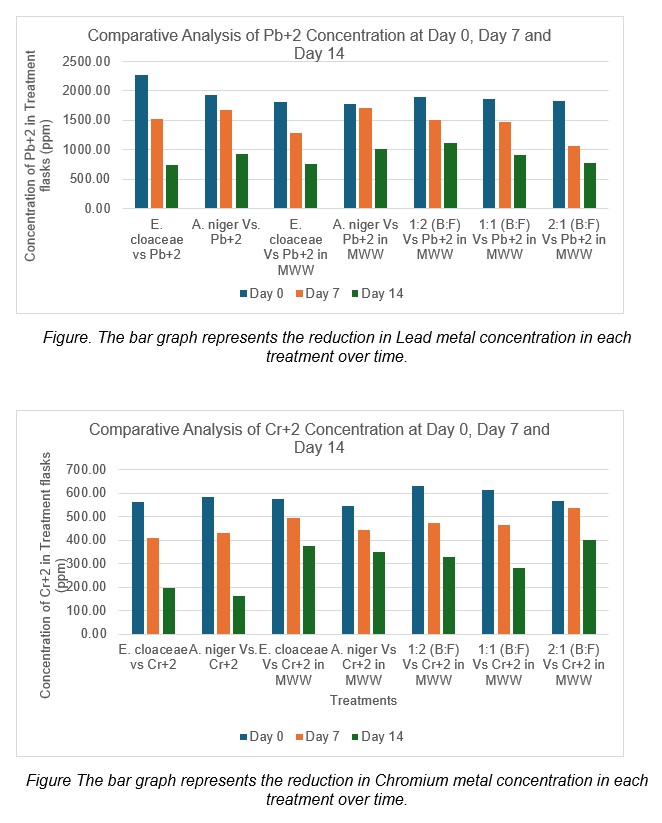
The study confirmed that, for synthetic sewage wastewater treatment, the consortium of A. niger and E. cloacae was more effective in bioremediation compared to the individual species, thereby validating our hypothesis. Among the tested ratios, the 2:1 (bacteria: fungal) ratio proved most efficient for lead bio-removal (57.58 % reduction), whereas the 1:1 ratio was optimal for chromium bio-removal (54.15 % reduction). These findings suggest that the consortium's performance can be optimized based on the specific metal contaminant.
Further studies should investigate the 2:1 and 1:1 ratios in actual industrial wastewater with elevated lead and chromium concentrations. Additionally, the bioremediation process for the 2:1 ratio should be assessed over an extended period, considering the slower growth rate of fungal cultures. Future research could explore innovative combinations of bacterial, fungal, and algal consortia to further enhance wastewater treatment efficiency.
Updated
1 year ago
Powered by Acadiate
© 2011-2026, Acadiate Inc. or its affiliates · Privacy