
 CLOSE SIDEBAR
SBP 27 - Reducing Escherichia coli in Plant-Based Meat with Lemon Juice and Vinegar
Plant-based meat products are food items derived directly from plants including legumes, grains, vegetables, soy products, nuts, and seeds to represent and replicate the appearance like taste, texture, flavor, nutritional value, etc. (Plant-Based Meat - an Overview | ScienceDirect Topics, n.d.).
According to the Government of Canada (2024), Escherichia coli is considered a foodborne pathogen that spreads by contact with infected persons, animals, contaminated surfaces, or contaminated food and water. Common sources of infection include undercooked or raw beef, unpasteurized dairy products, raw fruits and vegetables, and untreated water or juices. Contamination may also occur through contact with fecal matter of infected individuals, improper agricultural practices where water or manure is contaminated, and cross-contamination during food handling. According to The Canadian Press (2023), Canada has gone through many outbreaks of E. coli in the past, which underlines with more significance the need to enhance food safety measures.
Although plant-based meats are still vulnerable to E. coli contamination in the process of growing and harvesting their raw ingredients, this fact does not eliminate the seriousness of the public health challenge that it poses: contaminated plant-based meats can lead to serious health problems. For all such reasons, E. coli contamination of plant-based meat products becomes important research study areas.
The main objective of the experiment was to test the effectiveness of vinegar (2%) and lemon juice (2%) and their combined treatments on the survival of E. coli in processed plant-based meats by using the Standard Plate Counts (SPC) method.
The present work investigated the antimicrobial effects of 2% lemon juice, 2% vinegar, and their 1:1 combination on the reduction of Escherichia coli in plant-based meat products stored at 4°C for 168 hours.
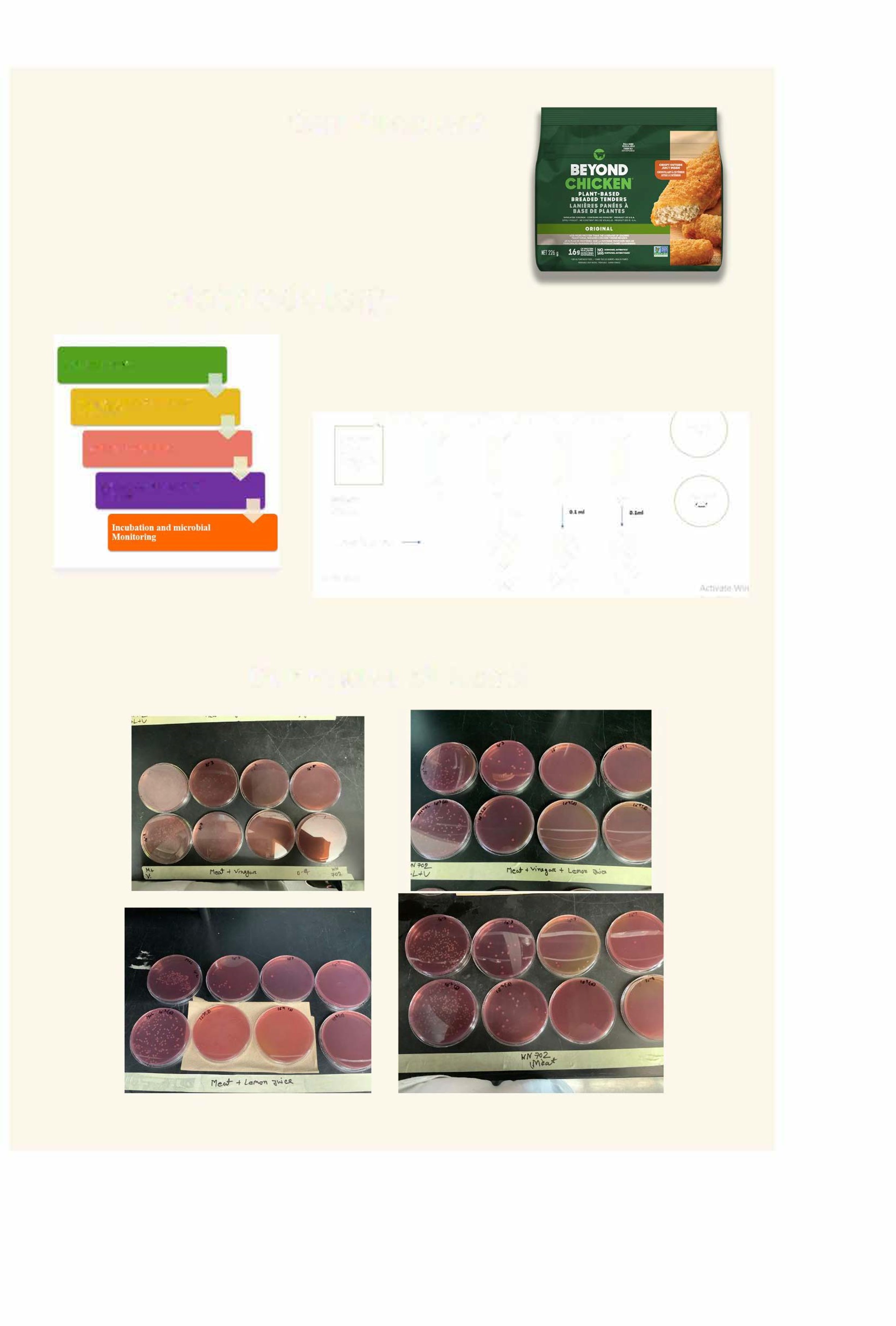
Breaded plant-based chicken patties from a commercial store were kept in the refrigerator, then treated with four types of treatment liquids: 2% lemon juice, 2% vinegar, the combination in a 1:1 ratio at 2%, and an untreated control. Each of the treatments entailed 25g of meat with 2.5 mL of
E. coli (ATCC 8739) at an approximate titer of 3.0 × 10⁷ CFU/mL.
The samples were stored for a maximum of 10 days at 4°C. The monitoring of samples microbiologically was conducted on days 0, 2, and 7, by homogenizing 5 g of treated samples in 45 mL of sterile phosphate buffer, then conducting a series of decimal dilutions in sterile phosphate buffer and plating onto MacConkey Agar. Plates were incubated for 24 hours at 37°C, with duplicate plates per treatment. These experiments were performed in duplicate to ensure reproducibility and, hence, reliability of data for the antimicrobial activities of the treatments.
Trial 1 showed unexpected population dynamics where the single applications of lemon juice and vinegar increased in population from 0 to 48 hours before decreasing through 168. The combination treatment remained steadily reduced in the E. coli populations. Conversely, the untreated had a continuous growth of bacteria throughout the storage periods.
Trial 2 gave stronger evidence to confirm the hypothesis, with all the treatment conditions showing a gradual and consistent decline in E. coli populations over the 168-hour observation period. Again, the combined use of lemon juice and vinegar at 1% concentration showed the highest rate of antimicrobial action and proved the hypothesis of the synergistic relationship between these two acidic agents. Individual treatment modalities showed comparatively slower rates of decline, indicating their limited action when used alone.
The findings confirmed that mixing lemon juice with vinegar is effective; above all, a 1:1 ratio is very effective because the acidity of the two mixed liquids has an additive effect. These findings mark a call to action for more dedicated antimicrobial approaches that may discourage the growth of bacteria in food products.
Updated
1 year ago
Powered by Acadiate
© 2011-2026, Acadiate Inc. or its affiliates · Privacy