
 CLOSE SIDEBAR
SBP 19 - Simplifying Gram Staining: A Cost-Effective 3D-Printed Solution for Rapid Bacterial Identification
Healthcare, Food safety, and scientific research are all profoundly affected by the importance of bacterial identification in microbiology. Clinicians can more accurately diagnose diseases, companies can keep tabs on contamination, and researchers can learn more about microbial diversity and behaviour, thanks to fast and accurate bacterial identification. Bacterial cell wall composition determines whether bacteria are Gram – positive or Gram – negative, and Gram staining is one of the most important methods for classifying bacteria. In laboratories with limited resources or in situations that demand high-throughput findings, the classic Gram staining procedure can be labour – intensive, time consuming, and prone to human errors despite its relevance.
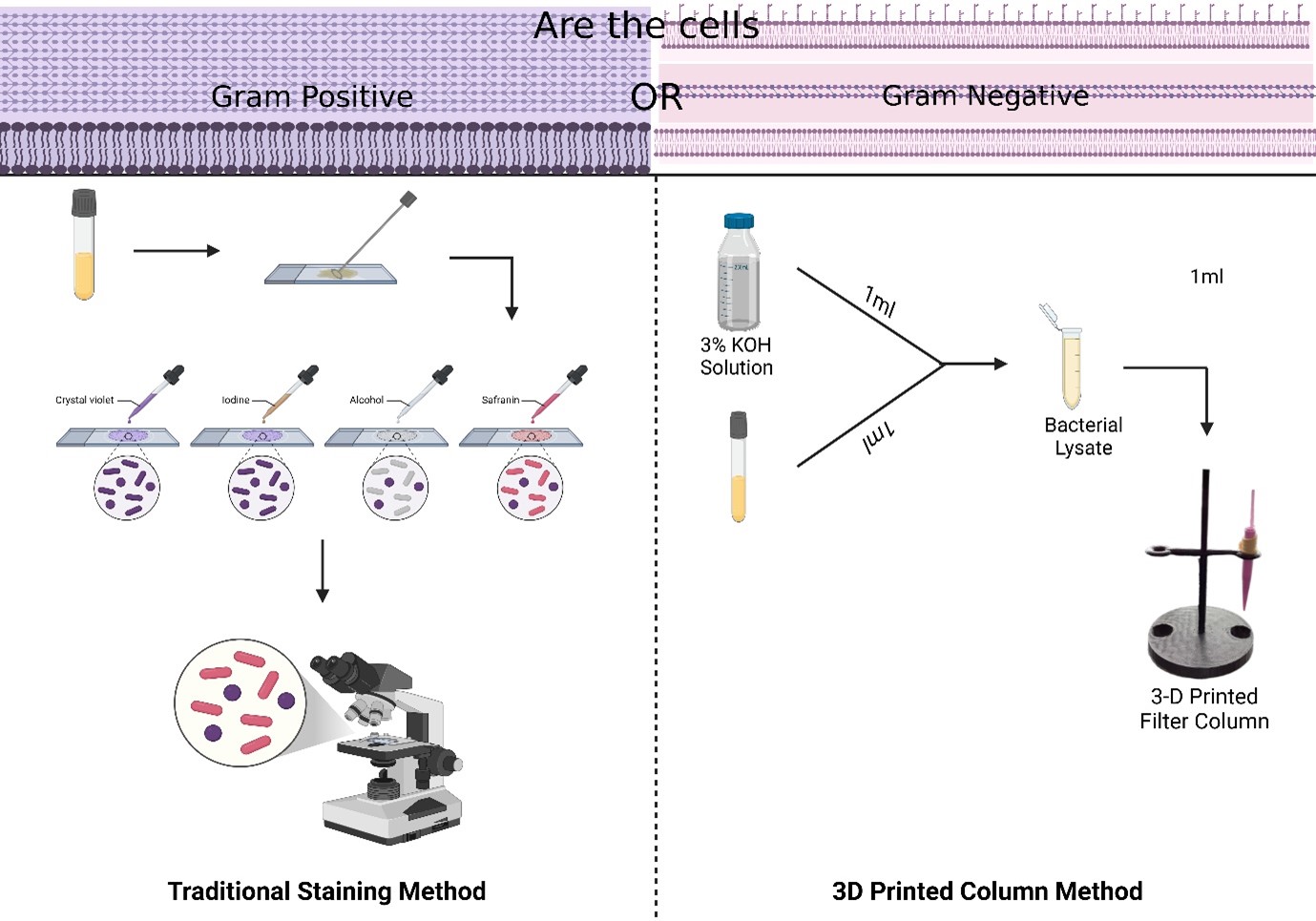
This study introduces a novel fast Gram identification kit that uses a 3D-printed filter column technology to address these issues. Thanks to its small size and intuitive design, this kit streamlines the Gram-staining procedure, making it easier to use and more reproducible. With the use of a 3D-printed column and a specially designed filter support, this device is able to optimise the staining technique by controlling the flow of reagents through bacterial suspensions and placing the filters precisely.
The revolutionary 3D-printed column system overcomes significant drawbacks of conventional approaches. Uneven reagent distribution and variable results are common outcomes of human handling of filter sheets in typical setups. Staining results are now clearer and more accurate thanks to this innovative column system, which fixes the cellulose filter disc in place and enables controlled flow of chemicals and bacterial components. The kit is useful for labs of all sizes since it cuts down on the possibility of procedural mistakes, which increases reliability and repeatability.
The design of the project is centred around making it affordable and accessible. The high cost of traditional Gram-staining techniques and equipment limits their usage in settings with limited resources. This idea provides an economical and expandable option by making use of 3D printing technology. Polylactic acid (PLA), a long-lasting and biodegradable polymer, is one of the more accessible and inexpensive materials that can be used to print parts of the filter column. Both the bottom line and environmental sustainability are enhanced by this.
One more thing that makes this kit useful is how it's designed to be assembled. This kit is great for instructional, clinical, and field use because the components are lightweight, portable, and reusable. Assembling, disassembling, and cleaning the filter columns is a breeze, so you can use them again without throwing them away. The system is perfect for underfunded labs or those in distant areas without easy access to traditional equipment because of these advantages.
The project's possible uses cover a wide range of sectors. The kit accelerates Gram staining in clinical laboratories, which allows for more rapid identification of bacteria and, consequently, more early treatment decisions. Assisting with the monitoring of microbiological contamination in food products, it guarantees compliance with safety standards in food safety and quality control. When standard equipment isn't an option, this kit gives researchers in the field and those doing remote diagnostics a portable and reliable way to classify bacteria on the spot. This project fills a vital need in microbiological diagnostics by overcoming the drawbacks of conventional Gram-staining methods. In the end, this study improves bacterial identification accuracy and efficiency and is a big step towards portable fast testing solutions that help schools, businesses, and healthcare. The fast Gram identification kit is a game-changer in microbiology and a model for how 3D printing might revolutionise other scientific fields by fusing theory with practice.
Updated
1 year ago
Powered by Acadiate
© 2011-2026, Acadiate Inc. or its affiliates · Privacy