
 CLOSE SIDEBAR
SBP 08 - Blue Light Against Common Skin Pathogens on Artificial Human Skin
Description:
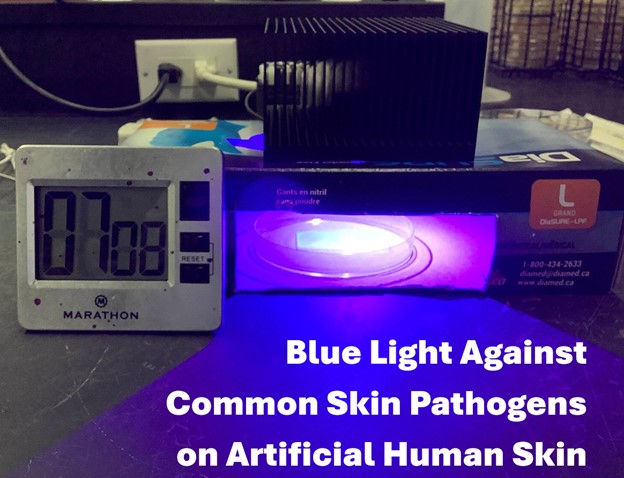
Antimicrobial resistance presents a constant struggle for scientists and physicians alike, research towards new antimicrobial strategies is necessary to counteract this growing concern. Through its ability to generate reactive oxygen species, blue light is capable of causing the degradation of microbial cells. In addition, blue light is a safer alternative to UV light, which damages host cells through its action on DNA and RNA. Studies have shown the efficacy of blue light treatment on a variety of microbial species. However, most of these studies were conducted on prepared media or animal subjects. This research was conducted on artificial human skin which was designed to mimic the physiological features of skin. The simulation of these key characteristics such as topography, pH and chemical reactivity allowed a relevant look into the efficacy of blue light and its combination with antimicrobial agents on the selected microbes.
In this research, preparations of common skin pathogens, Staphylococcus aureus, Escherichia coli, Enterobacter aerogenes (Klebsiella aerogenes), Pseudomonas aeruginosa, Klebsiella pneumoniae, and Candida albicans were individually inoculated into artificial skin which then was exposed to either blue light alone for 15 minutes or blue light for 7.5 mins in combination with a half dose of antimicrobial agent. The reduced dosage of antimicrobial agent and reduced exposure time was done to determine if the combination of treatments would potentiate each other’s antimicrobial action and have an equivalent effect as a full exposure time of blue light. After treatment, the artificial skin was serially diluted and spread plated. Following incubation of the prepared plates, colonies were enumerated and compared with the count obtained from untreated artificial skin to determine the efficacy of treatments.
Enumeration revealed that both blue light treatments caused a significant decrease in common skin pathogens inoculated into artificial human skin. The effect of 15 minutes of blue light exposure was most effective in E. coli, Enterobacter, and C. albicans, with a reduction of 98-99.99% compared to control. Pseudomonas and Klebsiella had a similar trend although with decreased efficacy with a reduction of 80-83%. Blue light alone was less effective against S. aureus, however the combination with antimicrobial agents produced better results, with a 72% reduction compared to 30% in standalone exposure.
Interestingly, 15 minutes of blue light exposure was more effective on gram negative bacteria and fungi, while the combination of reduced dose of antimicrobial agent and blue light treatment was more effective on gram positive bacteria. Despite the mixed efficacy towards the different microbial species, the result highlights the need for a combination of treatments particularly in infections involving more than one microbial species. Furthermore, it may be beneficial to investigate the persistence of this synergism of antimicrobial agents and blue light on resistant species such as Methicillin resistant S. aureus.
Although a reduced dose of antimicrobial agent and blue light was not as effective there was still a significant reduction in microbial colonies. Furthermore, the combination of 15 minutes of blue light exposure to a full dose of antimicrobial would be beneficial in the management of skin infections. Further investigation of antimicrobial agents with mechanisms of action that are more complementary towards the production of reactive oxygen species by blue light may provide better antimicrobial synergism. In addition, the use of different formulations of antimicrobial agents specific to skin such as topical ointments and lotions may provide a better simulation of real-world therapies.
Updated
1 year ago
Powered by Acadiate
© 2011-2026, Acadiate Inc. or its affiliates · Privacy