
 CLOSE SIDEBAR
IT 57 - Trends I.T. Consulting – New Site Installation for St. Lazarus Toronto Clinic
IT Projects
Trends I.T. Consulting's comprehensive project for St. Lazarus Toronto Clinic demonstrates the fundamental need of information technology (IT) solutions in modern healthcare institutions. With a primary focus on establishing a new clinic location, our project seeks to provide smooth operations and optimal IT infrastructure, allowing the clinic's expansion plans. The project's purpose and goals are broad, involving a variety of critical components such as infrastructure design, hardware installation, cabling, network configuration, and network security implementation.
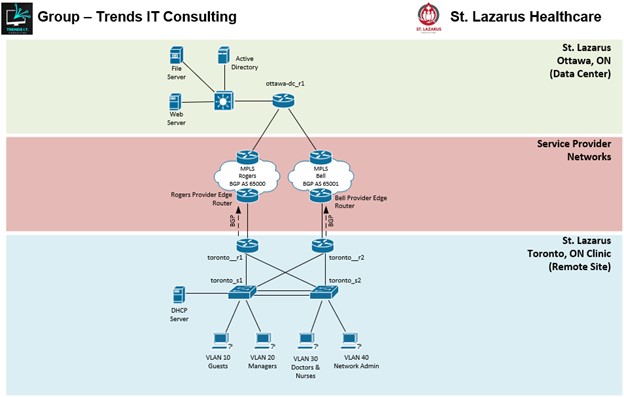
The project begins with a careful infrastructure design phase, during which our team meticulously maps out and builds a network infrastructure adapted to the specific demands and scalability requirements of the new site. This phase establishes the groundwork for the following activities, ensuring a unified and efficient network configuration. Hardware installation follows suit, with the deployment and configuration of routers, switches, and other critical network services to create a fully functional network environment. During this phase, our diligent attention to detail ensures that the network architecture is reliable and performs properly.
To maintain optimal network operations in our project for St. Lazarus Toronto Clinic, we needed to manage IP addresses meticulously. We thoroughly planned and documented IP address assignments, subnets, and VLAN configurations to eliminate IP conflicts and simplify network administration. We used the IP Address Management (IPAM) document to track IP address utilization, dynamically allocate addresses via DHCP, and reserve static addresses for important devices. This thorough approach reduced downtime, increased troubleshooting efficiency, and enabled future scalability.
Security implementation is critical to our project, as we do thorough vulnerability assessments and proactively resolve any identified security concerns. We protect the clinic's network infrastructure from potential cyber-attacks and breaches by using a variety of strong security measures. Our proactive security approach demonstrates our dedication to protecting the confidentiality, integrity, and availability of important patient data and operating systems.
In this project for St. Lazarus Toronto Clinic, we created a strong set of protocols and network services to assure dependability, security, and smooth operations. For Wide Area Network (WAN) connectivity, we used Multiprotocol Label Switching (MPLS) with Border Gateway Protocol (BGP) for efficient routing and static routing for specific network paths. Within the Local Area Network (LAN), we implemented Virtual LANs (VLANs) for network segmentation, EtherChannel for link aggregation, and Inter-VLAN routing for communication across VLANs. We set up IP Helper to make it easier to assign IP addresses across networks. Redundancy was achieved via a Single Multihomed Solution, which was augmented by Hot Standby Router Protocol (HSRP) and IP Service Level Agreement (SLA) monitoring. SSH remote access, Route Maps for traffic manipulation, Access Control Lists (ACLs) for traffic filtering, BGP authentication for BGP session security, and the VLAN Trunking Protocol (VTP) for VLAN management all contributed to improved network security. To ensure effective clinic operations, critical network services such as Active Directory, DHCP Server, DNS Server, Remote Desktop Protocol (RDP), and Windows Internet Information Services (IIS) server were also deployed. These protocols and services work together to provide a strong and complete network architecture adapted to St. Lazarus Toronto Clinic's specific requirements, ensuring dependability, security, and optimal performance.
Throughout the project lifecycle, excellent coordination and collaboration among project team members, such as IT consultants and network engineers, are critical. Clear communication channels and regular progress reports guarantee that the project stays on track and meets the clinic's overall goals.
In essence, the project conducted by our group is more than just a technical endeavor; it demonstrates our common commitment to excellence, creativity, and collaboration. By using our knowledge, resources, and collaborative culture, we are certain that the clinic will not only meet its immediate goals, but will also emerge stronger and more resilient in the face of future challenges.
In summary, our group's project is an in-depth effort to improve the clinic's IT infrastructure and support its expansion plans. We hope to help the clinic succeed in today's digital healthcare environment by providing efficient network integration, strong security measures, and dependable connectivity. We are devoted to guaranteeing the clinic's technological and operational success now and in the future through rigorous planning, and diligent implementation.
Updated
2 years ago
Powered by Acadiate
© 2011-2026, Acadiate Inc. or its affiliates · Privacy