
 CLOSE SIDEBAR
EN 30 - Smart waste aggregator
Energy Projects
Background
Canada is the top country in waste production according to the recent statistics and therefore, proper waste segregation and processing of the waste is the need of the hour. As the world is realising and witnessing the impacts of climate change and global warming, every country is focusing on mindful resource management leading to sustainable future. Apparently, the concerns regarding resource depletion and environmental degradation have led to reutilization and recycling of materials in every country. This shift in the mindset of each country reflects the recognition of earth’s resources are limited and sustainable practices are the only way ahead to ensure the well being of the current and future generations. For pacing towards sustainable future, along with ethical considerations and consumer behaviour, government across globe are implementing regulations and policies to achieve waste reduction and enhance recycling procedures. Government regulations include mandates for utilization of recyclable materials, conditions for proper waste management and disposal, and tax benefits for achieving reduced green house gas emissions.
Problem
From the year 2002 to 2020, the amount of solid waste contributed by Canada alleviated by 5.3 million tons; 17 percent to reach 36 million tons. The consequences of improper waste segregation led to severe environmental impacts such as land quality deterioration and resource depletion, health impacts such as aesthetic degradation and infectious diseases spread. For instance, despite the availability of various separate bins for effective waste segregation such as paper waste, plastic, recyclables and other bins at centennial college marketplace, many students fail to segregate waste effectively. The contamination of the non-recyclable items in the recyclable materials bin contributes to inefficiencies in waste management. Even though there are pictorial representations at these bins to engage with the consumer to properly segregate the waste, there are limitations of manual waste segregation and consumer behaviour and disregard for proper waste disposal practices. This led to the need for technological solutions such as implementation of a smart waste segregator using Arduino, metal(aluminium) and plastic detectors, to avoid human interaction and utilizing automation to improve the segregation and making the system dummy proof.
Purpose
The work described in the technology report was undertaken as the incorporation of the smart waste segregators at locations such as marketplace at Centennial college and various food junctions helps in avoiding improper segregation (Cleanrobotics,2002). With the help of sensors segregating recyclable materials effectively, consumers do not have to think and avoid making a mistake while in a rush. Automation of the waste segregation process leads to increased efficiency, increased convenience, minimize human error, reduced labor costs, and improved overall waste management practices. Continuous recycling and reutilization of resources, smart segregators contribute to the circular economy model by closing the loop on waste generation and resource consumption.
Working
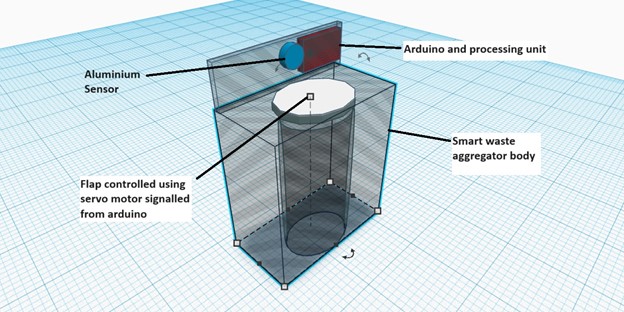
Smart waste aggregator unit using aluminium sensor and servo motor to accept only the recyclable cans inside the bin helping the waste segregation procedure. Figure 1 shows the picture of the unit which includes various components of the system namely, Arduino, aluminium sensor, flap controlled with servo motor, and the aggregator body. The working of the model is such when the consumer will bring the empty cans or recyclable cans in front of the sensor of the dustbin, the aluminium sensor will detect the recyclable cans and send either a positive or negative signal to the Arduino. Furthermore, depending on the signal received from the sensor, the Arduino has a preset ‘if and else’ program installed which will send the signal to the servo motor connected flap to whether open the flap of the bin and allow the waste to be accepted or declined. The servo motor depending on the signal received from Arduino, if it is a positive signal, the flap will rotate by 90° and the recyclable cans will be deposited in the bin. If the signal received from the Arduino is negative, the servo motor will not rotate and won’t accept the waste as it would potentially be not recyclable and reject the waste.
Scope
The project on Smart waste segregator prototype model installed at the marketplace at Centennial college can provide with statistical evidence in the difference and improvement ratio post the installation. The recorded data helps in evaluation of the success of the system and further pitch the system to various other locations and organizations to scale it to the maximum potential. The limitations that could impact the report are the technical challenges such as compatibility issues with existing waste management, infrastructure, software errors and sensor malfunctions. In addition, external factors such as changes in municipal waste collection patterns, seasonal impacts on the components could potentially affect the report.
Updated
2 years ago
Powered by Acadiate
© 2011-2026, Acadiate Inc. or its affiliates · Privacy