
 CLOSE SIDEBAR
EN 16 - Harnessing Waste Heat: Exhaust Duct Thermoelectric Generator
Energy Projects
The utilization of waste heat presents a significant challenge in both industrial and residential sectors. Traditional exhaust systems expel substantial amounts of thermal energy, contributing to environmental degradation and economic inefficiency. Addressing this issue requires innovative approaches to capture and convert waste heat into usable energy. Our project aims to address this issue by designing and implementing an exhaust duct thermoelectric generator (“edTEG”) system. By harnessing wasted heat through innovative technology, this project aims to not only reduce energy waste but also contribute to sustainable practices and resource conservation.
During the winter season, the energy rate is at its highest. This is mostly because of the heating process in every building. Thus, Canada has most of its months in cold to cooler conditions. We have thought of making the most of the temperature difference that occurs during this season and integrating it into our project. The temperature difference is a vital factor in the thermoelectric concept. As the interior of the exhaust duct gets heated, the exterior is cooled by the atmosphere (and in some cases: snow, wind, and rain can be contributors). This is the key principle of the Seebeck Effect where the temperature difference between two points can effectively generate electricity.
[Objectives]
Our objectives include designing an efficient duct system with heatsinks, integrating a thermoelectric module, optimizing the edTEG system, and evaluating its performance across various conditions. By converting wasted heat into valuable energy, this project aims to promote sustainability and drive societal and economic change.
A. Design an efficient exhaust duct system with heatsinks:
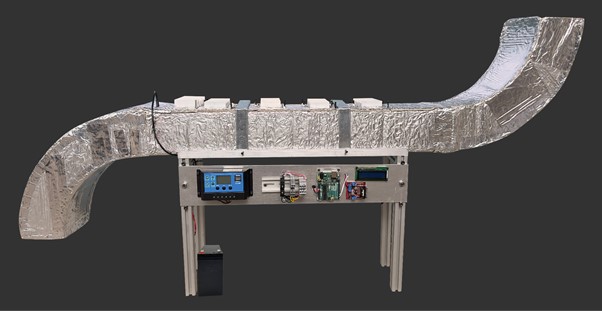
The first objective focuses on the design aspect of the project. It involves creating a duct system equipped with heatsinks that are strategically placed like baffles to capture waste heat efficiently. This design ensures that the heatsinks can effectively transfer heat to the thermoelectric module.
B. Implement a thermoelectric module between the heatsinks:
Once the duct system is designed, the next objective is to integrate thermoelectric modules between the heatsinks. These modules are crucial as they serve as the core component responsible for converting captured heat into electrical energy through the Seebeck effect.
C. Optimize the edTEG system:
This objective involves fine-tuning and optimizing the entire exhaust duct thermoelectric generator system for maximum energy conversion efficiency. Optimization may include adjusting parameters such as the placement of heatsinks, the selection of thermoelectric materials, and the configuration of the electrical circuitry to enhance performance.
D. Evaluate the performance under different conditions:
The final objective revolves around testing and evaluating the performance of the edTEG system under various operating conditions. This includes assessing its efficiency in converting waste heat into electrical energy across different temperature differentials, airflow rates, and environmental factors. The evaluation process helps validate the effectiveness of the designed system and provides insights for further improvements.
Methodology
The construction and assembling of the edTEG were based on existing heating, ventilation, and air conditioning (HVAC) exhaust designs. The metal ductwork was sourced from a metal shop and specifically fabricated with our desired prototype measurements. Fifteen 12V 6A thermoelectric modules were connected in series and placed in between the heatsinks. The heat will be absorbed by the modules and converted to energy. Hence, the Seebeck effect will be achieved. Sensors that were placed inside and outside the duct were used to determine the temperature differences. An Arduino was programmed and used to control the electricals and aid the operation of the L298N motor driver to power the cooling fan and exhaust fan accordingly. The cooling fan’s role is to maintain a temperature difference on the cold side. Also, the exhaust fan will prevent the hot air/flue gas from being trapped inside the duct. A 12V battery will serve as the energy storage which is connected to a charge controller.
The scope of this project
The scope of this project includes the design, construction, and testing of a prototype exhaust duct TEG system. Specifically, the project will focus on integrating heatsinks within the duct to capture waste heat efficiently. A thermoelectric module will be placed between the heatsinks to convert the captured heat into electrical energy. The project will involve optimization of the edTEG system to maximize energy conversion efficiency under various operating conditions.
Evaluation
The success of the project will be evaluated based on the efficiency of the edTEG system in converting waste heat into electrical energy, as well as its feasibility for real-world applications in industrial, commercial, and residential settings.
Conclusion
In conclusion, the development of an exhaust duct thermoelectric generator (edTEG) system represents a significant step towards addressing the challenges of energy waste and environmental degradation. By capturing and converting wasted heat into usable electrical energy, this project not only promotes resource conservation but also facilitates the transition toward sustainable energy practices.
The successful implementation of edTEG systems in both commercial and residential settings holds promise for widespread adoption and positive societal impact. Furthermore, the innovation and technological advancements achieved through this project have the potential to drive economic growth, create new opportunities in renewable energy sectors, and inspire further research and development in the field of waste heat recovery.
As we move towards a future characterized by sustainability and energy efficiency, projects like this play a crucial role in shaping a better world for generations to come.
Updated
2 years ago
Powered by Acadiate
© 2011-2026, Acadiate Inc. or its affiliates · Privacy