 CLOSE SIDEBAR
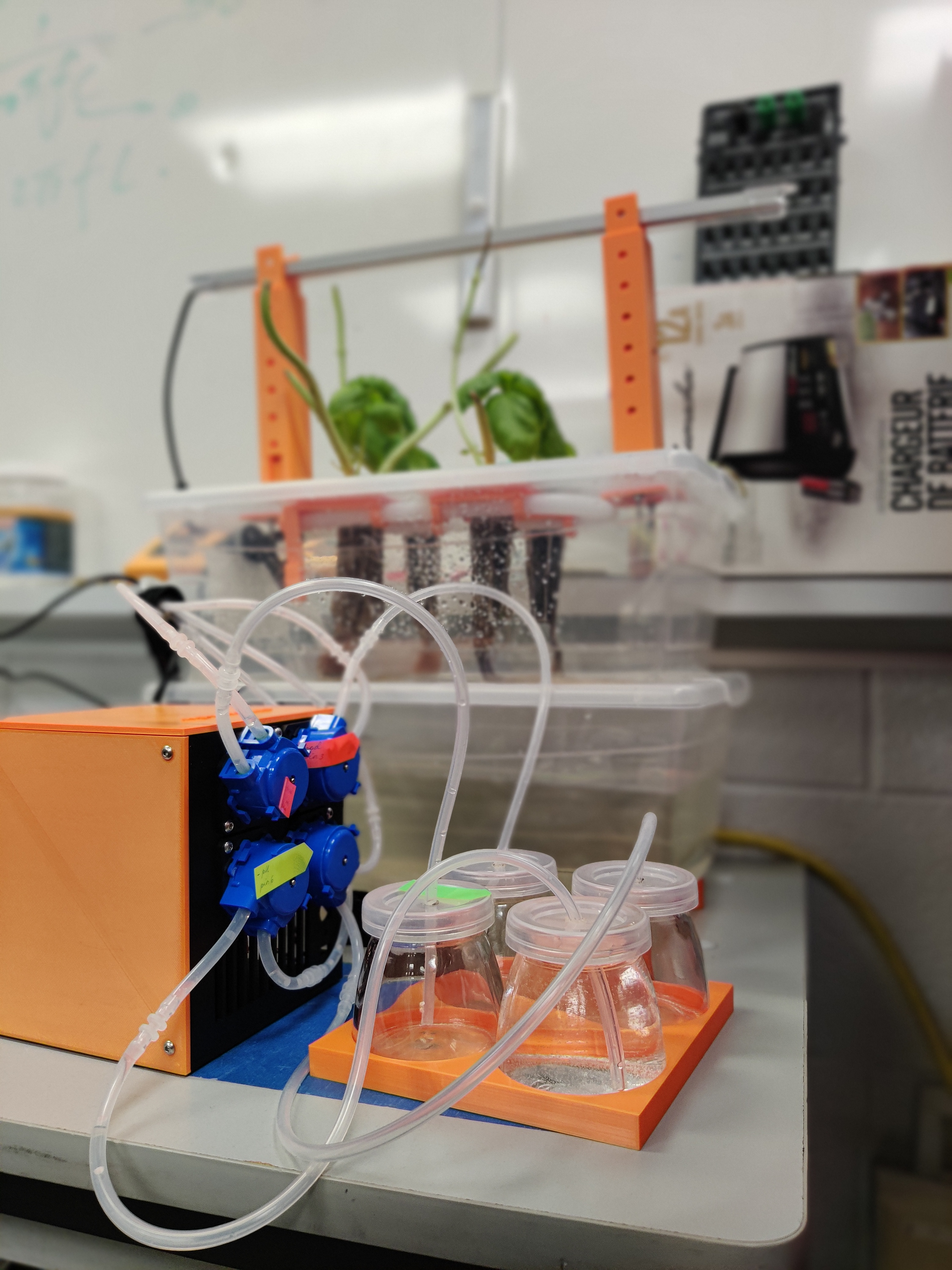
Automated Hydroponics for Residential Occupancies
Growing greener with hydroponics: Cultivate fresh produce sustainably at home
Our project seeks to promote sustainable and resilient food systems in residential settings by introducing an innovative automated hydroponic system that allows for year-round indoor cultivation of fresh and nutritious produce. By reducing the need for traditional soil-based farming practices and relying on efficient hydroponic techniques, our system reduces the environmental impact of food production while also promoting healthier and more sustainable dietary choices for individuals and communities. By providing a convenient and accessible solution for home-based food production, we aim to empower individuals to take an active role in shaping their own food systems, promoting food security and community resilience in the face of challenges such as climate change and resource scarcity.
The scope of this project is to develop a horizontal hydroponic system that can be used in a residential setting. The system is designed to occupy limited space and features automated control using Microcontrollers (ESP32 and Arduino UNO) for parameters such as turbidity, pH control, temperature control, water pumps, and dosing pump control for feeding the plant. The system also includes LED lights, nutrient supplementation, and a webpage for monitoring the sensor output. The system will be used to grow lettuce and basil in a controlled microenvironment with reduced water usage, no need for fertilizers, and no use of pesticides. By eliminating soil erosion, reducing fossil fuels, and producing more plants, this project is an eco-friendly and sustainable solution for home-based agriculture.
The main benefits of hydroponics can be exemplified in the following article, which based itself on large scale farming. However, if scaled down to individual home use, the same data would still be relevant: https://www.ncbi.nlm.nih.gov/pmc/articles/PMC4483736/
Some extracts:
Water consumption between the hydroponic and conventional production of lettuce in Arizona was comparable on an area basis, but when normalized by yield the average was 13 ± 2.7 times less water demand in hydroponic production compared to conventional production. Specifically, hydroponic lettuce production had an estimated water demand of 20 ± 3.8 L/kg/y, while conventional lettuce production had an estimated water demand of 250 ± 25 L/kg/y
In terms of yield per area, the hydroponic production of lettuce in Arizona was found to be 11 ± 1.7 times greater than that of its conventional equivalent. Specifically, hydroponic lettuce production was calculated to result in a yield of 41 ± 6.1 kg/m2/y (±standard deviation, SD, here and in the following), while conventional lettuce production was projected to yield 3.9 ± 0.21 kg/m2/y
Elements used in this project:
- ESP32 Programmable Microcontroller with WIFI module
- Arduino UNO / Elengo
- 4 units of Gikfun 12V DC Dosing Pump Peristaltic Dosing Pumps
- 1 unit of Gikfun DC 3V 5V Micro Submersible Mini Water Pump
- Set of LED strings working at full spectrum of 3500K to 6500K.
- 1 unit of 7.5 mm Plastic Tube
- 1 unit of pH Meter (Liquid PH Value Detection detect Sensor Module Monitoring Control for Arduino BNC Electrode Probe)
- 1 unit of Turbidity Sensor (KEYESTUDIO Water Quality Turbidity Meter Detector Monitor Sewage Test Tester Sensor Kit for Arduino)
- 1 unit of Temperature Sensor (Gikfun DS18B20 Waterproof Digital Temperature Sensor with Adapter Module is a set of 3 sensors)
- 1 unit of Water level sensor (Anndason 6 Pieces Black Water Level Sensor)
- 1 unit of Channel DC 5V Relay Module with Optocoupler.
- 2 units of LM2596 DC to DC Voltage Regulator. One from 24V to 12V and another to step down from 24V to 9V.
- 2 units of L298N 12V DC motor drivers.
- 1 unit of L293D Driver
- 1 unit of 12 V Cooling fan
- 1 unit of SS60-DD Solid-State Relay (5V output)
- 2 pairs of niobium magnets.
- 2 units of Plastic Container (6 liters)
- 4 units of AeroGarden Basil seeds in peat Sponges
- 3D printed adjustable rack for LED
Procedures:
On-line Monitoring
ESP32 features the Wi-Fi module that communicates with external server. The server is represented by Arduino IOT cloud. Within the cloud, the user can see the widgets that displays the following parameters of their Automated Hydroponic system: temperature, turbidity, and pH. The cloud can be accessed via Arduino Smartphone app. The user can then issue a simple command through the app to manually activate initiate recirculation, pH control, activating mixer or adding nutrients. The app is free to download and only requires a presence of internet connection.
Circulation
At the state of rest, the system keeps recirculating the water with dissolved nutrients from lower container to the one on top for the period of 5 minutes with the intervals of 20 minutes in between circulations. The circulation is performed by DC 3V 5V Micro Submersible Mini Water Pump. The top container is filled to the maximum of 1 gallon of water, which would be indicated by activation of water level sensor which, in turn, would send the feedback signal to ESP32. The ESP32 would then issue the command to Arduino UNO via Serial Communication to disable the Water Pump for the next 20 minutes. The tube of the water pump is attached underneath the lid of the top container, closely passing by each plant pod. Sets of small holes are made in the tube to promote effective plant irrigation, whenever the tube passes closely to plant pod. Bottom of the top container features a set of drain holes to provide natural drainage of water back to the bottom container for further recirculation. Circulation timer resets every 24 hours to avoid system fault and provide continuous circulation.
pH control
Liquid PH Value Detection detect Sensor Module is submerged into the lower container. When powered, the sensor performs a set of 50 measurements every 24 hour. Signals are sent to ESP32 which derives an average pH value and determines whether the pH of water is within the allowable range between 6.5 to 7.5. In the situation that the pH value passed either lower or upper limits – ESP32 sends the command to Arduino UNO to actuate one of the pH pumps. Depending on determined level of pH, either +pH or -pH pump will send a predetermined number of drops (10 drops) of concentrated pH agent via Gikfun 12V DC Dosing Pump Peristaltic Dosing Pump to the bottom container (-pH or +pH is sent by different pumps). The other end of each pump is connected to the bottle with its respective pH controlling agent. Pumps are then turned off. Seconds later ESP32 issues the command to Arduino to activate the mixer to shake the water in the lower container to evenly distribute newly added pH agent across the volume of the container. The process of mixing looks as followed: 12V DC Cooling fan is station under the center of the bottom container. Two niobium magnets are attached to the flaps of the fan. Directly above the fan, yet inside the container, lies a plastic flap with another set of niobium magnets. The rotation of cooling fan is inducing rotation in the flap that gradually mixes the water inside the bottom container. The process of mixing lasts for 1 minute. The fan will then turn off. pH sensor will then wait for another 24 hours to repeat the measurement.
Nutrient Supplement
In our project we are using two Nutrient bases that must be added in equal amount in the quantity of 7.5 ml every week. The system is set to automatically determine the elapsed time. Once elapsed, ESP32 will issue the command to the other two Dosing Pumps to activate them in sequence with 3 second interval in between them. Each pump, is connected to its respective nutrient solution. As with pH control, the pumps will send a predetermined amount of nutrient solution (7.5 ml of each) to the bottom container. The pumps will then turn off. In few seconds the fan will be initiated and will proceed with mixing the water in the bottom container for the next 1 minute. The mixer will then turn off. The system will then wait for another week to automatically add next portion of nutrients.
Temperature
Gikfun DS18B20 Waterproof Digital Temperature Sensor with Adapter Module is connected to ESP32 to send the temperature data. The continuously monitored temperature data is displayed at Arduino IOT cloud. The optimal temperature range for hydroponic plants growth is defined to be between 16 to 21 Celsius.
Turbidity
KEYESTUDIO Water Quality Turbidity Meter Detector is used to determine whether the user need to change the water in the container. Plants gradually release their byproducts into the water which must be replaced periodically (typically once every 2 weeks). Turbidity sensor communicates with ESP32, which in turn sends the turbidity data to the IOT cloud, displaying it as one of the widgets for the user to see.
Drivers
L293D driver is used to operate circulation pump and mixing fan. It takes its 5V Vcc from Arduino and 12V of Vcc2 is supplied by 24V power supply, after being reduced to 12V by voltage regulators.
Voltage Regulation
The initial 24 V input is split reduced to 12V and 9V.
- 24 V to power LED strip
- 12V to power 4 Dosing pumps, 1 circulation pump and 1 cooler fan.
- 9V to power Arduino and ESP32 modules.
LED lights
LED strings working with 3500K to 6500K. The natural light spectrum for plant growth lies between 2700K to 7000K. The LED string used in this experiment provides red, blue and white light for the span of 15 hours per day, automatically turning off for 8 hours and turning on in repeating cycles.

Powered by Acadiate
© 2011-2026, Acadiate Inc. or its affiliates · Privacy