
 CLOSE SIDEBAR
EL 01 - Spectroscopic Pregnancy and UTI Test
Electronics Project
Traditional, single-use pregnancy tests are wasteful, generating over 22.5 tonnes of plastic waste annually. They are also conspicuous to purchase, store and use. In order to overcome common barriers to accessing care and to revolutionize the pregnancy test market, we aimed to create a reusable, electronic pregnancy test that was as sensitive as conventional strip tests and that empowered the user by offering a discreet, reliable and reusable test. It was our hope that this device would benefit a variety of potential end users such as non-profits, healthcare organizations, religious, and rural communities.
The concept for our design was based on well-known applications of spectroscopy and employed simple principles of transmittance, absorbance, and concentration to detect both human chorionic gonadotropin (HCG), the pregnancy hormone, and E. coli, a common cause of urinary tract infections (UTI) in women. Our objective was to design and build a functional proof-of-concept device that consistently detects the transmittance of dilute sample solutions and calculates the solution’s concentration using that spectral data.
Most current methods for hormone or bacteria detection in biological samples incorporate bioassays and the enzymatic immunoreactivity of the analytes with chemical test strips. Our device was designed to detect the concentration of HCG and E. coli by measuring the absorption of light in two distinct wavelengths.
Much like a common oxygen saturation (SpO2) sensor, the optical pregnancy test aims to measure absorbance at the analytes’ peak absorption wavelength. Since HCG has peak absorbance and fluorescence at 475nm, blue light is used for hormone detection. Unlike HCG, E. coli does not have resonant fluorescence and so even though its’ peak fluorescence is at 340nm, the recommended wavelength for measuring E. coli absorbance is 600-650nm.
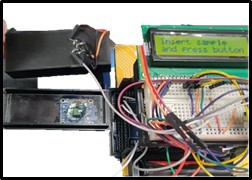
The device consists of three main components: a light source (incident light), a spectral sensor and a microprocessor. An LDC screen and a pushbutton were also interfaced with the microprocessor in order to incorporate user input and to provide feedback. Specifically, we used an Elegoo Mega 2560 Arduino microprocessor, an Adafruit AS7267 visible spectral sensor, a 16x2 Character LCD Module, a 469nm (blue) LED, a 590nm (orange) LED and a standard 4-pin pushbutton.
Existing Arduino libraries were used to establish serial connection between the microprocessor and the spectral sensor, and to interface the LCD, whereas the main function code was written from scratch. The main function prompts the user for a reference sample, shines the blue then orange LEDs in one second intervals, then records the values of incident light intensity. The user is then prompted for a sample slide and the process is repeated, except that the intensity values stored are for the transmitted light. Concentration is then calculated using the reference (incident) and sample (transmitted) light intensity values and displays either a positive or negative test result on the LCD.
Parameters for indicating negative or positive pregnancy are conventionally based on the concentration of HCG in mIU/mL, where a concentration below 5 mIU/mL is a confirmed negative result, and anything above 25 mIU/mL is a confirmed positive result. UTI has been associated with E. coli level at or above 105 CFU/ml urine, so this would be the threshold value for indicating bacterial infection. Since the Beers-Lambert law considers the molar concentration in mol/L, however, relevant threshold concentrations for both HCG and E. coli must be converted to the same unit of measure (approximately 2.083 x 10⁻¹⁰ mol/L for and 4.598 x 10⁻⁹ mol/L respectively).
For testing the device, we used a chlorophyll solution rather than synthetic HCG or E. coli. HCG has a peak absorbance of 470nm and Chlorophyll a has a peak absorbance in the range of 430- 470nm. We were unable to find a reliable source for the molar weight of HCG – a figure that is critical for concentration calculations – whereas the molar weight of Chlorophyll a (893.51g*mol-1) is well documented. An additional benefit of using chlorophyll is that it is a food-grade solution that is safe for uncontrolled use. Other ingredients in the chlorophyll solution have peak absorbance below 250nm and are therefore not expected to influence the blue light intensity readings. This is a fairly good simulation of HCG in urine as HCG has 470nm peak absorbance and urea’s peak absorbance is below 200nm.
In order to test the device, we mixed two solutions using a ‘super concentrate’ that had 100mg Chlorophyll a/5mL of liquid. The first solution was approximately 0.025mL chlorophyll concentrate into five millilitres of water, and the second solution was approximately 0.125mL chlorophyll concentrate into five millilitres of water. Using the concentration of the undiluted solution and the molar mass of Chlorophyll a, we calculated that solution 1 had a concentration of 1.11361E-4 mol/L and solution 2 had a concentration of 5.45942E-4 mol/L.
We ran tests with both solutions 10 times and recorded two blue light intensity values per run: 1) reference and 2) sample. For each iteration the lid was removed as if inserting the glass slide for the reference reading and then again for the sample reading (since the glass slide absorbs a small amount of blue light it is included in the reference reading so that the absorbance of the glass is not misconstrued as absorbance of the sample). The lid was returned to the same "locked" position towards the user and against the Arduino.
The test results showed a significant difference between the transmitted light intensities of solutions 1 and 2, indicating that the higher concentration sample (solution 2) allowed less light to pass through, even if not to the degree that was expected. Concentration results from the test did not align with the known concentration of our test solutions, but still demonstrated that relatively small changes in concentration are being detected by the device.
Updated
2 years ago
Powered by Acadiate
© 2011-2026, Acadiate Inc. or its affiliates · Privacy