
 CLOSE SIDEBAR
EL 01 - Prototype Design for Muscular Fatigue Detection During Manual Lifting Using sEMG Signals
Musculoskeletal disorders (MSDs) represent a major challenge in industrial settings, with repetitive manual lifting being a significant contributing factor. Among these disorders, lower back conditions account for 42% of reported cases, often resulting in decreased productivity and long-term health complications. Despite advancements in ergonomics and safety protocols, there is a notable lack of real-time, objective tools to monitor and mitigate muscle fatigue. To address this gap, our project proposes a scalable, user-friendly, and effective solution to enhance workplace safety and minimize injury risk.
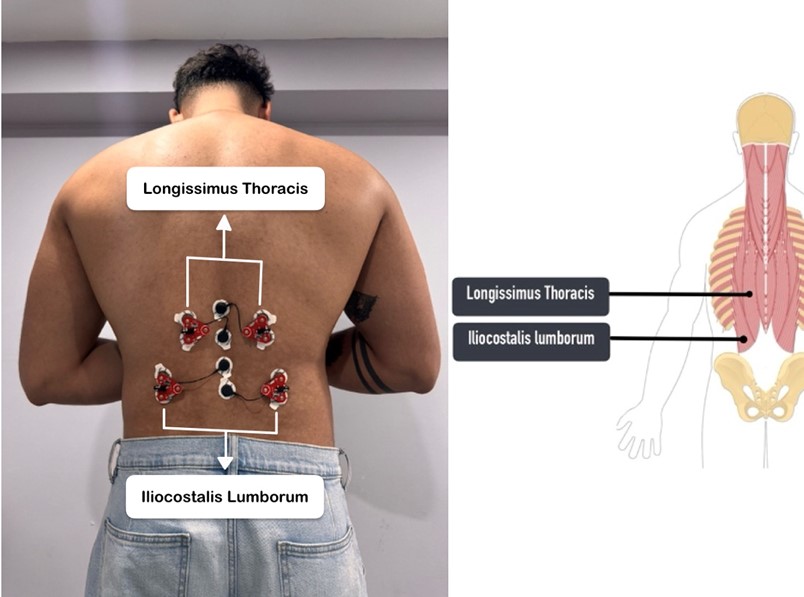
We developed a wearable system that monitors and detects muscle fatigue in real-time during repetitive lifting tasks. This system employs Surface Electromyography (sEMG) to measure activity in the Longissimus Thoracis and Iliocostalis Lumborum muscles of the lower back. By integrating advanced signal processing with intuitive feedback mechanisms, the system identifies early signs of fatigue and provides immediate alerts to help users avoid overexertion and potential injuries. The solution combines hardware, software, and real-time visualization to deliver actionable insights on muscle performance.
The sEMG system encompasses several key functionalities:
Real-Time Muscle Monitoring
The system utilizes Myoware 2.0 sEMG sensors to record electrical signals from muscles. These signals are processed by an Arduino microcontroller, where they are normalized and prepared for further analysis.
Fatigue Detection: The system employs Fast Fourier Transform (FFT) analysis to evaluate changes in signal frequency and amplitude, critical indicators of muscle fatigue. The Arduino communicates with MATLAB for this analysis, leveraging a dynamic threshold that adjusts to the user’s baseline muscle activity, ensuring personalized and precise fatigue detection.
Feedback Mechanisms: Upon detecting fatigue, the system activates LEDs, a buzzer, and sends SMS notifications to alert users. This multi-modal feedback enables timely interventions, such as taking breaks or modifying lifting techniques.
Data Visualization: Real-time data, including raw and processed sEMG signals, fatigue metrics, and contraction patterns, is displayed on a MATLAB interface and a Node-RED dashboard. This comprehensive visualization enhances the user’s understanding of their muscle activity.
System Reliability: The system incorporates redundancy by separating data streams for the right and left sides of the lower back. This ensures continuous monitoring, even in the event of a single sensor failure.
The inspiration for this project stems from the pressing need to address a critical gap in workplace safety practices. While organizations like the National Institute for Occupational Safety and Health (NIOSH) and the Canadian Centre for Occupational Health and Safety (CCOHS) promote proper lifting techniques, there remains a lack of objective tools to monitor muscle fatigue. Workers engaged in repetitive manual lifting may not always recognize when they are nearing their physical limits, leaving them vulnerable to injury. Existing fatigue assessment methods rely heavily on subjective self-reports, which can be unreliable.
This project also provided an opportunity to deepen our expertise in biological signals and signal processing, areas closely aligned with my background in bioengineering and biomedical engineering. It allowed me to apply theoretical knowledge to a real-world problem, advancing my skills while contributing to a meaningful solution.
The development process for this project involved the following main stages:
1. Hardware Design
Myoware 2.0 sEMG sensors were used to collect muscle signals, which were transmitted to an Arduino Uno R4 WiFi microcontroller. Sensors were strategically placed on the Longissimus Thoracis and Iliocostalis Lumborum muscles for optimal signal acquisition. To improve usability, the system was designed as a wearable belt.
2. Signal Processing
Signals were normalized to a range of 0 to 5 volts and analyzed using MATLAB. FFT was applied to detect shifts in the median frequency, a reliable indicator of muscle fatigue. A dynamic threshold was implemented to adapt the system to individual users and varying workloads.
3. Data Transmission and Visualization
Processed data was transmitted via HTTP protocol to a Node-RED dashboard, which displayed real-time metrics and trends. This dashboard provided an intuitive interface for users to monitor muscle activity.
4. Feedback Integration
The system incorporated visual (LED), auditory (buzzer), and text-based (SMS) feedback mechanisms. These alerts were designed to prompt immediate action, such as resting or adjusting technique, to mitigate fatigue-related risks.
This project demonstrates the potential of wearable technology to improve workplace safety. By enabling real-time monitoring of muscle fatigue, it empowers workers to take proactive measures to reduce the risk of injury. Employers benefit from improved worker well-being, reduced downtime, and lower healthcare costs.
Beyond industrial applications, this technology could be adapted for use in physical rehabilitation, sports performance, and other areas where muscle fatigue monitoring is essential. By integrating advanced sEMG signal processing with user-friendly interfaces and robust feedback systems, this project exemplifies how bioengineering solutions can address critical challenges in health and safety.
Updated
1 year ago
Powered by Acadiate
© 2011-2026, Acadiate Inc. or its affiliates · Privacy