
 CLOSE SIDEBAR
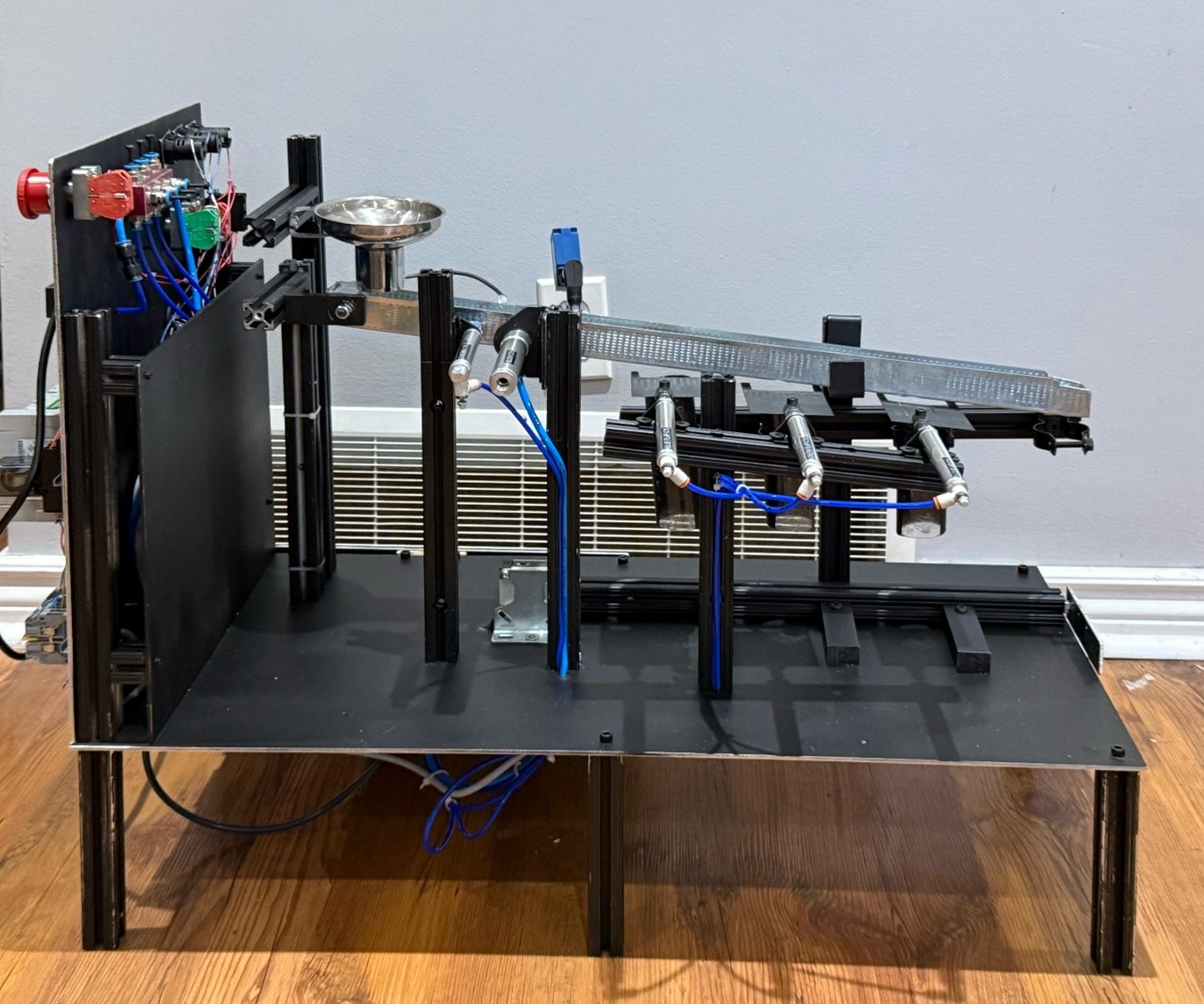
AR 05 - Colour Sorting Machine
This project focuses on the design and development of an automated Colour Sorting Machine that uses sensor technology, pneumatic actuators, and programmable logic control (PLC) to identify and sort objects based on their colour. Developed as part of the ROBO366 Design and Development Project 2 in the Automation and Robotics Technology program at Centennial College, the machine is engineered to improve the speed, accuracy, and efficiency of sorting operations in industrial environments.
The machine’s design is centered around a gravity-fed aluminium C-channel structure, which allows objects (such as coloured balls) to roll down an inclined path. This design eliminates the need for conveyor belts and motors, resulting in minimal power consumption. A hopper at the top guides the objects into the channel, where they are temporarily held by a blocking cylinder until sorting begins. A proximity sensor confirms the presence of an object before it reaches the colour sensor, which identifies its colour. The data is processed by an Allen-Bradley Micro 830 PLC, which then triggers the appropriate pneumatic actuator to divert the object into its designated bin. If the colour is not recognized, the object is sent to a default bin.
The mechanical structure is both lightweight and robust, using aluminium components to maintain durability without compromising on ease of assembly. The slope angle of the channel was optimized during testing to ensure smooth movement while preventing object jamming. Adjustments to the surface texture and angle were made to resolve issues with friction and ball movement. To improve flap control, notches were added to the pneumatic flaps, ensuring they remain aligned during sorting.
On the electrical side, the integration of sensors and actuators with the PLC was a key focus. Colour sensors and proximity sensors are strategically placed for optimal detection. All components are connected through a centralized control panel that houses the PLC, relays, solenoid valves, and power supply. The pneumatic system, which controls both the sorting flaps and object gates, includes cylinders, pressure regulators, and solenoid valves, providing consistent and smooth actuation.
Throughout development, the team conducted troubleshooting activities to overcome technical challenges. These included sensor misreadings due to ambient light, surface friction causing objects to stop mid-channel, and flap misalignment due to actuator rotation. Each issue was resolved through component upgrades, mechanical modifications, and PLC reprogramming.
The performance goals for the Colour Sorting Machine included high sorting accuracy, fast cycle times, and reliable pneumatic actuation. Initial testing has shown promising results, and the project is on track for full validation and deployment. The machine's modular design allows it to be easily adapted for different object types, making it a scalable solution for various manufacturing sectors.
In conclusion, this project successfully combines mechanical, electrical, and automation engineering principles to develop a cost-effective and energy-efficient sorting system. Future work will focus on refining sensor calibration, optimizing PLC logic, and conducting extensive system testing to ensure industrial readiness. The Colour Sorting Machine stands as a valuable addition to automated manufacturing, offering increased productivity, reduced human involvement, and enhanced reliability.
Updated
1 year ago
Powered by Acadiate
© 2011-2026, Acadiate Inc. or its affiliates · Privacy