 CLOSE SIDEBAR
EDI in Action: A Comparative Analysis of the Integration of EDI withing the Building Sector Strategies of the Climate Action Plans for Canada's Major Urban Centres
Osayuwame Ize-Iyamu
This research paper aims to explore how social vulnerabilities have been considered through the integration of Equity, Diversity, and Inclusion (EDI) themes within the building sector strategies of the climate action plans of four of the major urban centres in Canada: Toronto, Montreal, Vancouver and Calgary. The scope of the research study covers new developments of residential buildings that were four storeys or higher, and non-residential buildings (industrial, commercial,and institutional developments). The study is guided by the following research questions: how is EDI conceptualized in the literature?; how can these be used as a framework to assess the building sector strategies?; and what are the results of applying the EDI framework to the building sector strategies of the four major urban centres in Canada? To effectively answer these questions an extensive literature review was conducted to conceptualize equity, diversity and inclusion within the built environment and climate action planning and supplemented by four semi-structured interviews with city staff.
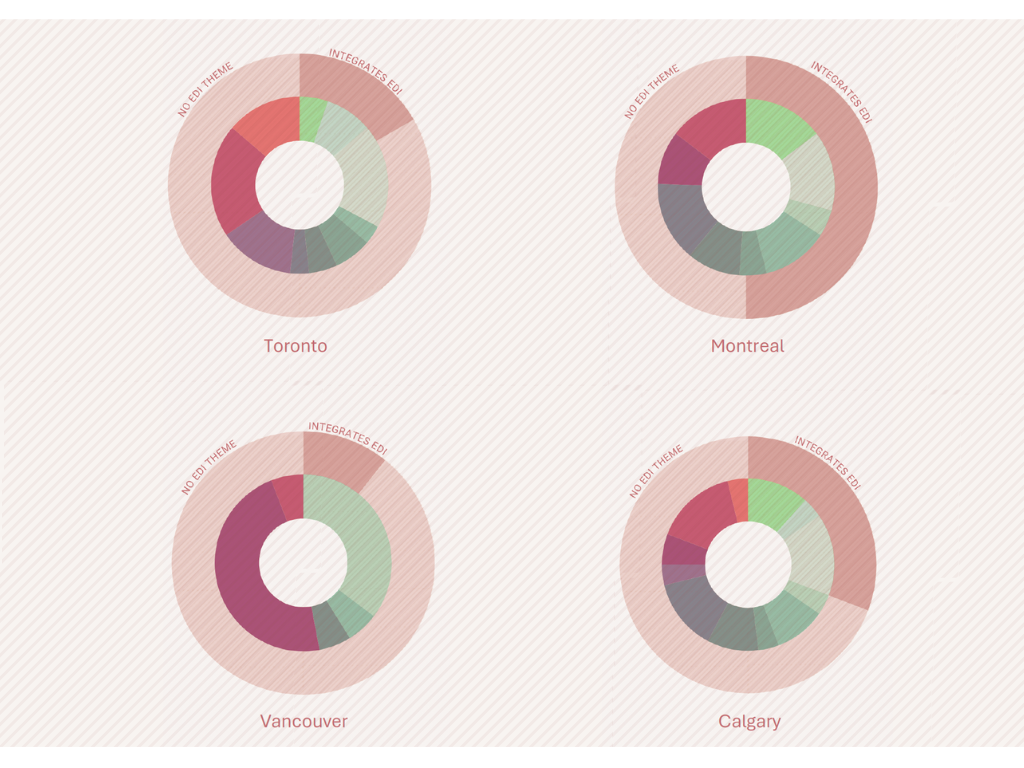
Through the inductive coding of the literature, there were seven equity themes, three diversity themes and three inclusion themes that were extracted to form the EDI framework which was used to perform the comparative analysis of the building sector strategies. These themes include climate justice, environmental justice, distributional justice, procedural equity, recognitional equity, intergenerational/intragenerational equity, vulnerable populations, marginal groups, persons with disabilities, participation/engagement, accessibility, and inclusive design. The findings from the comparative analysis shown in the results section focus on the published strategies of the climate action strategies at the time of this research, after the EDI evaluation framework was applied. To get these values the strategies were assigned 1 point for each theme fully incorporated, and half when partially considered.
The implication of this study provides a comprehensive framework for policymakers, planners, developers, and AEC practitioners, to better integrate EDI consideration into the strategies of climate action plans for the buildings sectors, and other sectors critical to the low-carbon economy transition.

Powered by Acadiate
© 2011-2026, Acadiate Inc. or its affiliates · Privacy