 CLOSE SIDEBAR
 Live Session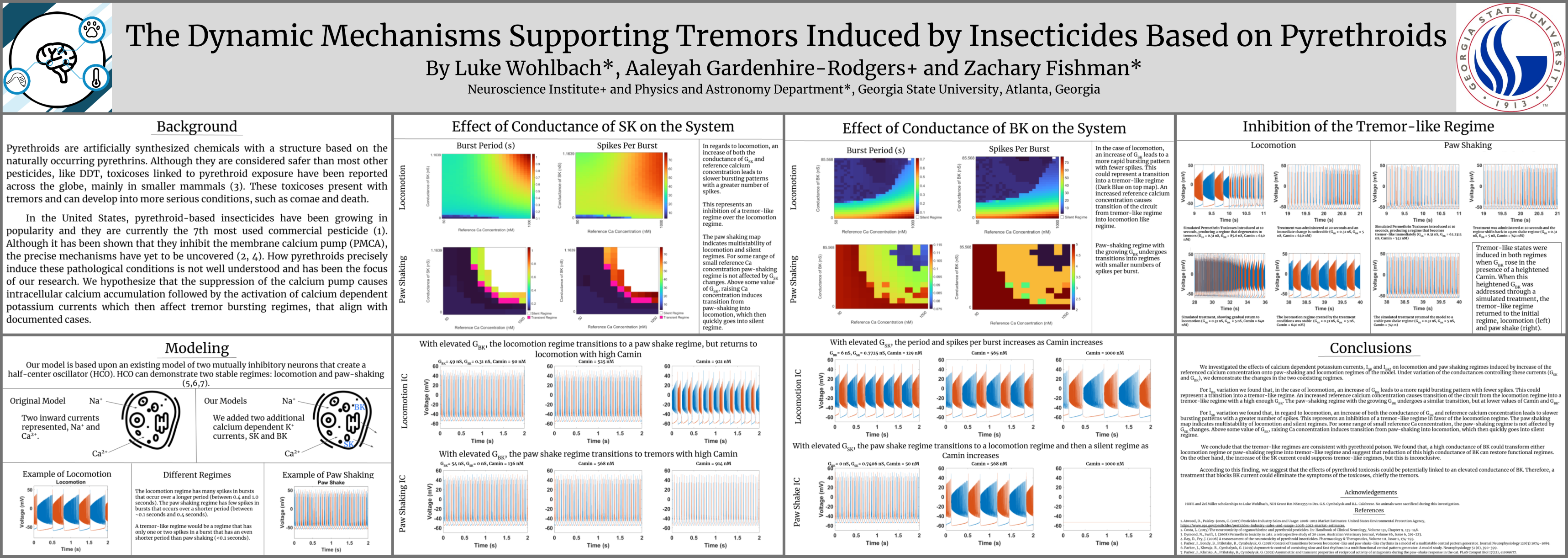
The Dynamical Mechanisms Supporting Tremors Induced by Insecticides Based on Pyrethroids
Luke Wohlbach, Aaleyah Gardenhire-Rodgers and Zachary Fishman (Dr. Cymbalyuk)
In smaller mammals like cats (Dymond et al., 2008), tremors, seizures, and coma have all been linked to pyrethroid poisoning. Insecticides based on pyrethroids are the 7th most common kind of pesticide used in the United States (Ray et al., 2006, Atwood, 2017). Pyrethroids suppress the voltage-gated sodium and potassium currents and the calcium pump in insects (Costa, 2015). How pyrethroids induce these pathological conditions, including tremors, is not well understood. We hypothesize that the suppression of the calcium pump causes intercellular calcium accumulation followed by the activation of calcium dependent currents (SK, BK, Cl) which then promote tremor bursting regimes.
In this investigation, a CPG is modeled by a system of two neurons which mutually inhibit each other thus creating a half-center oscillator (Parker et al., 2018, 2019, 2021). Both neurons have two slow inward currents, a Na+ current (INaS) and Ca2+ (ICaS). This model exhibits two distinct regimes that represent locomotion and paw-shaking behaviors in cats. The locomotion regime is slow with a period of 1 second and the paw-shaking regime is fast with a period of 0.1 seconds. We hypothesize that the paw-shaking regime could become dysfunctional under exposure to pyrethroids and represent tremor activity. We upgrade this model with calcium dependent currents (ISK, IBK, ICl). By sweeping conductances controlling these currents, we show changes in the two coexisting parameter regimes based on the buildup of intercellular calcium concentration. We demonstrate these mechanisms facilitate generation of tremor bursting activity.
In conclusion, these investigated mechanisms could be mitigated by targeting calcium dependent currents (ISK, IBK, ICl) and calcium dynamics, thus, suggesting new medical treatments. Because of the increasing popularity of pyrethroids, knowledge of these precise mechanisms will be essential for the development of further medical treatments.
Acknowledgements: HOPE and Zel Miller scholarships to Luke Wohlbach, NIH Grant R21 NS111355 to Drs. G.S. Cymbalyuk and R.L. Calabrese. No animals were sacrificed during this investigation.
References
Atwood, D., Paisley-Jones, C. (2017) Pesticides Industry Sales and Usage: 2008-2012 Market Estimates: United States Environmental Protection Agency, https://www.epa.gov/pesticides/pesticides-industry-sales-and-usage-2008-2012-market-estimates.
Costa, L. (2015) The neurotoxicity of organochlorine and pyrethroid pesticides. In: Handbook of Clinical Neurology, Volume 131, Chapter 9, 135-148.
Dymond, N., Swift, I. (2008) Permethrin toxicity in cats: a retrospective study of 20 cases. Australian Veterinary Journal, Volume 86, Issue 6, 219-223.
Ray, D., Fry, J. (2006) A reassessment of the neurotoxicity of pyrethroid insecticides. Pharmacology & Therapeutics, Volume 111, Issue 1, 174-193.
Parker, J., Bondy, B., Prilutsky, B., Cymbalyuk, G. (2018) Control of transitions between locomotor-like and paw shake-like rhythms in a model of a multistable central pattern generator. Journal Neurophysiology 120(3):1074–1089.
Parker, J., Khwaja, R., Cymbalyuk, G. (2019) Asymmetric control of coexisting slow and fast rhythms in a multifunctional central pattern generator: A model study. Neurophysiology 51 (6), 390-399.
Parker, J., Klishko, A., Prilutsky, B., Cymbalyuk, G. (2021) Asymmetric and transient properties of reciprocal activity of antagonists during the paw-shake response in the cat. PLoS Comput Biol 17(12), e1009677.

Powered by Acadiate
© 2011-2026, Acadiate Inc. or its affiliates · Privacy