 CLOSE SIDEBAR
 Join Meeting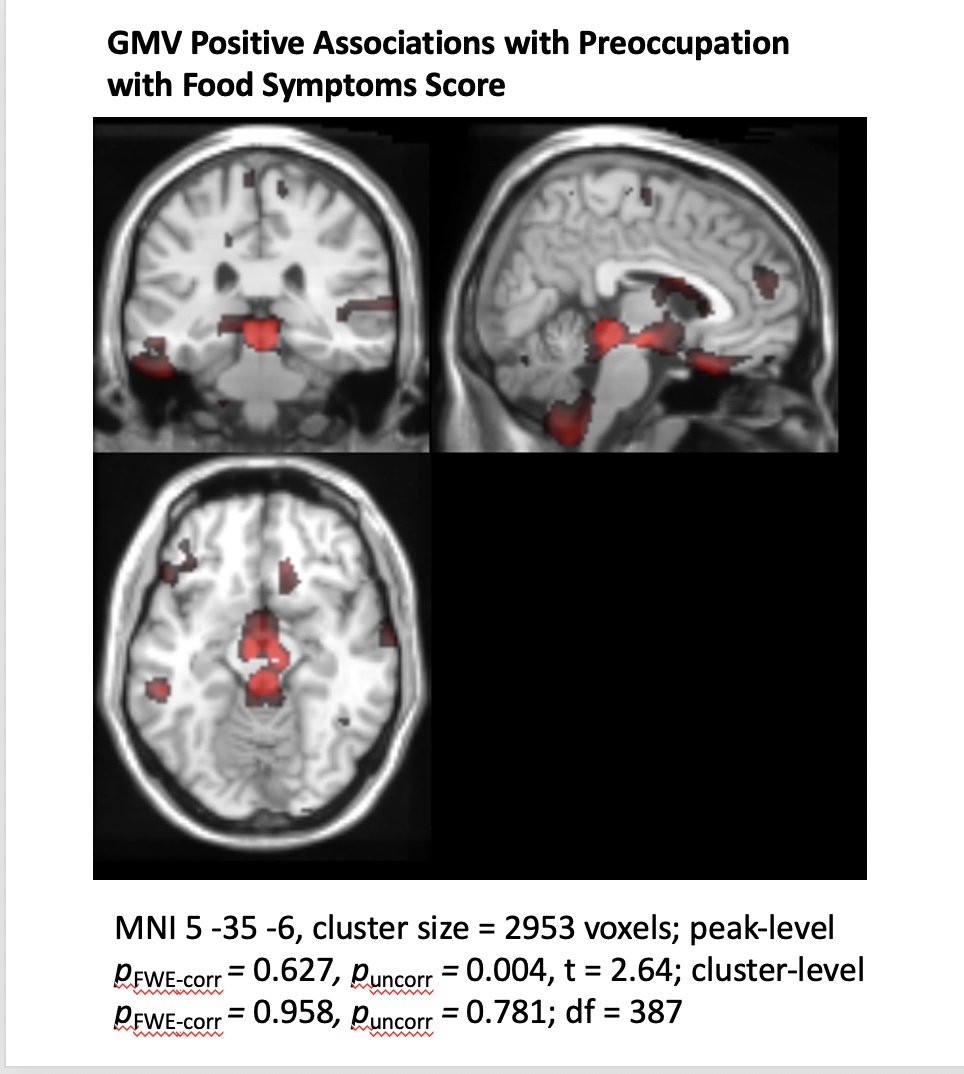

GSURC Presentation 2022
Title: Predicting Gray Matter Volumes from Eating Pathology Factors
Authors: Jody Finch, Chantal P. Tusher, and Jessica A. Turner
Faculty Sponsor: Dr. Chantal P. Tusher, Psychology & Dr. Jessica A. Turner, Neuroscience
Introduction: A recent review by Finch and colleagues (2021) summarizing the literature on gray matter volume (GMV) alterations associated with dimensions of eating pathology indicated that regions involved in emotional, visuo-spatial, attentional, and self-related processing were associated with restriction while regions involved in reward value of stimuli related to food and motivation/emotion processing were associated with disinhibited eating. However, much of the current literature is limited to diagnostic categories among adolescent and young adult female populations with little consideration for symptom-level relationships. To date, there is little literature investigating the extent to which the associations between factors of eating pathology are uniquely associated with GMV after controlling for possible confounding variables (e.g., scanner, sex, total intercranial volume).
Current Study: The current study used whole-brain voxel-based morphometry in a sample of adolescents between 11-and-17 years old to examine associations between structural variation and factors of eating-related behaviors: disinhibited eating, negative emotions associated with eating, preoccupation with food, and restriction.
Method: Participants included 393 11-17 year-olds (Mage = 13.54 ± 1.76; 36.1% female) who had structural MRI data, as well as self-reported disinhibited eating, negative emotions associated with eating, preoccupation with food, and restriction. We investigated the specificity of GMVs in predicting eating pathology factors using a whole-brain, FWE-corrected (p<0.05) flexible factorial design. Analyses were controlled for age, total intercranial volume, type of MRI scanner, and MRI scanner site.
Results: While previous research found alterations in GMV associated with disinhibited eating and restriction, the current study found no such significant associations.
Discussion/Implications: Results suggest that eating pathology factors are not uniquely associated with alterations in GMV after controlling for possible confounds. This may be a result of limitations in power and the metrics used to assess eating pathology as we used an uncommon assessment of eating pathology in the evaluation of clinically relevant eating behaviors. However, results may also indicate that the neurobiology of eating pathology is not specific to symptom clusters but may be more generalizable to all of eating pathology broadly. Future research should investigate if GMVs alterations are found to be generalizable to all eating pathology using a more commonly accepted eating pathology assessment (e.g., Eating Disorder Examination Questionnaire) in larger samples.