 CLOSE SIDEBAR
 Join Meeting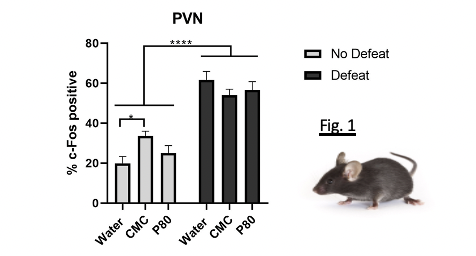

Social stress-induced C-Fos expression in mice that consume dietary emulsifiers
Abstract
Emulsifiers are food additives that are currently added to many processed foods. These emulsifiers are classified by the Food and Drug Administration (FDA) as safe for consumption, but recent findings suggest that they can be proinflammatory and may not be as inert as previously believed. In a previous study, we demonstrated that emulsifiers increased gene expression of immediate early genes in two brain regions that modulate stress responding in animals and that the consumption of dietary emulsifiers increased social avoidance, which suggests emulsifiers increased social stress sensitivity in mice. The purpose of this study is to determine whether consumption of dietary emulsifiers changes neural activity in stress-responsive brain regions following exposure to social stress. A method to infer neural activation is to examine c-Fos immunohistochemistry. The overarching question of this study is “does emulsifier consumption increase c-Fos expression in areas of the brain that modulate behavioral and hormonal responses to social defeat stress?” To answer this question, mice were treated with 1 of 3 treatments for 12 weeks: drinking water with no emulsifiers or water with 1% sodium carboxymethylcellulose (CMC) or 1% polysorbate-80 (P80). This concentration of emulsifiers is currently determined to be safe for consumption according to the FDA. Then, mice experienced either three, 5 min social defeats or the control condition wherein they were placed in the empty cage of an aggressive opponent. The mice were sacrificed 90 minutes after defeat or novel cage exposure, and the brains were collected for detection of c-Fos expression by immunofluorescence. Positive c-Fos neurons were counted, using the application CellProfiler, in 4 different brain regions: the medial prefrontal cortex (specifically the infralimbic cortex and prelimbic cortex), nucleus accumbens, paraventricular nucleus of the hypothalamus, and amygdala, and c-Fos counts were compared across defeat and emulsifier conditions. This is the first study to assess how emulsifier consumption affects brain activity following social stress. If this study demonstrates that the consumption of emulsifiers changes activity in stress-modulatory brain regions, then these food additives may increase sensitivity to stressful events and may increase the risk of developing stress-related neuropsychiatric disorders.