 CLOSE SIDEBAR
 Join Meeting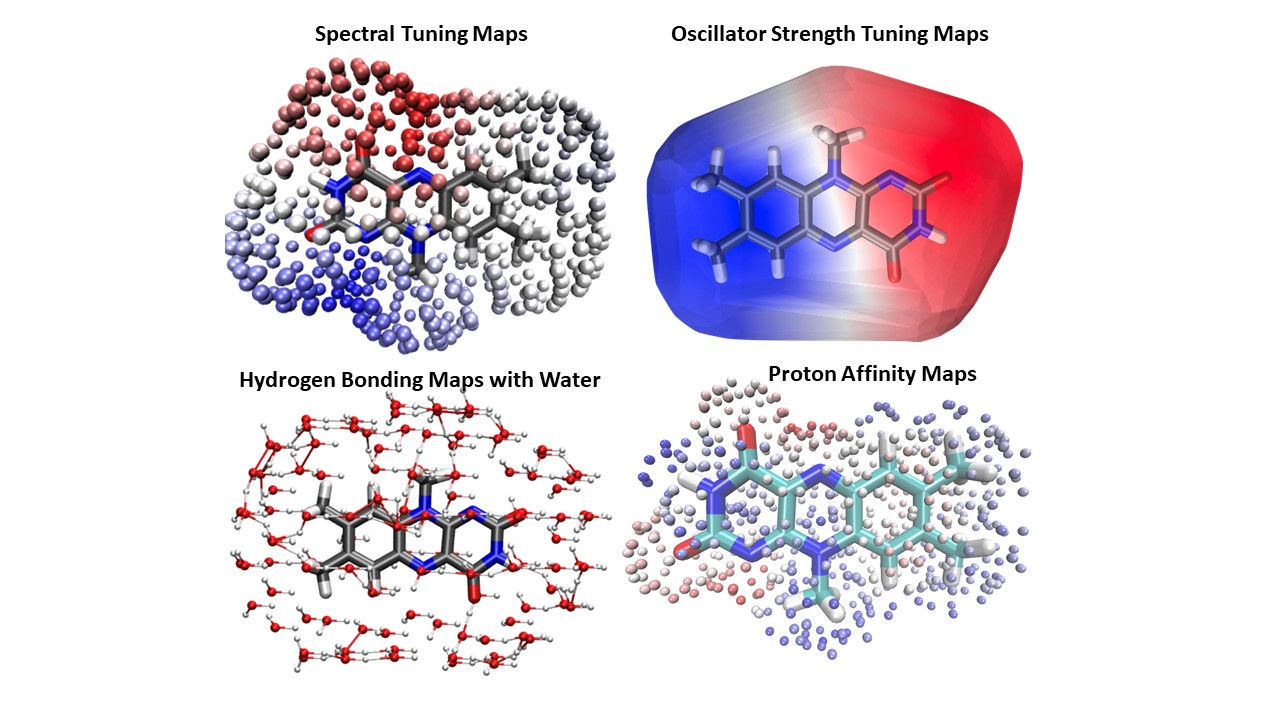
Visualization of the Environment’s Effect on Molecular Observables Through Electrostatic Tuning Maps
James Gay
A molecule’s properties and the corresponding experimental observables (e.g., electronic excitation energies probed by UV-visible spectroscopy, vibrational frequencies probed by IR spectroscopy, nuclear shielding probed by NMR chemical shifts, proton affinities, etc.) are affected by that molecule’s environment. For example, the same molecule might have different properties/observables in different solvents. Similarly, a molecule (e.g., a co-factor) hosted by a protein is affected by the inhomogeneous intermolecular interactions it experiences with the nearby protein residues. To better understand how a molecule’s properties are tuned by its surroundings, our lab has been developing Electrostatic Tuning Maps (ETMs). These maps are developed by constructing a Van Der Waals radius around a molecule and placing points on the surface. These points can be converted to charges, molecules, or atoms to simulate environmental effects on the molecule of interest. Such maps have been developed for modeling the effect of charges on UV-visible absorption wavelength and intensity, the effect of hydrogen bonding on vibrational frequencies, and, more recently, for mapping proton affinities. In the later case, by using hydrogen ions in place of points, we locate proton-accessible parts of the molecule that have the highest proton affinity. Such ETMs that can serve both as valuable educational and research tools to investigate trends on molecular properties.

Powered by Acadiate
© 2011-2026, Acadiate Inc. or its affiliates · Privacy