 CLOSE SIDEBAR
 Join Meeting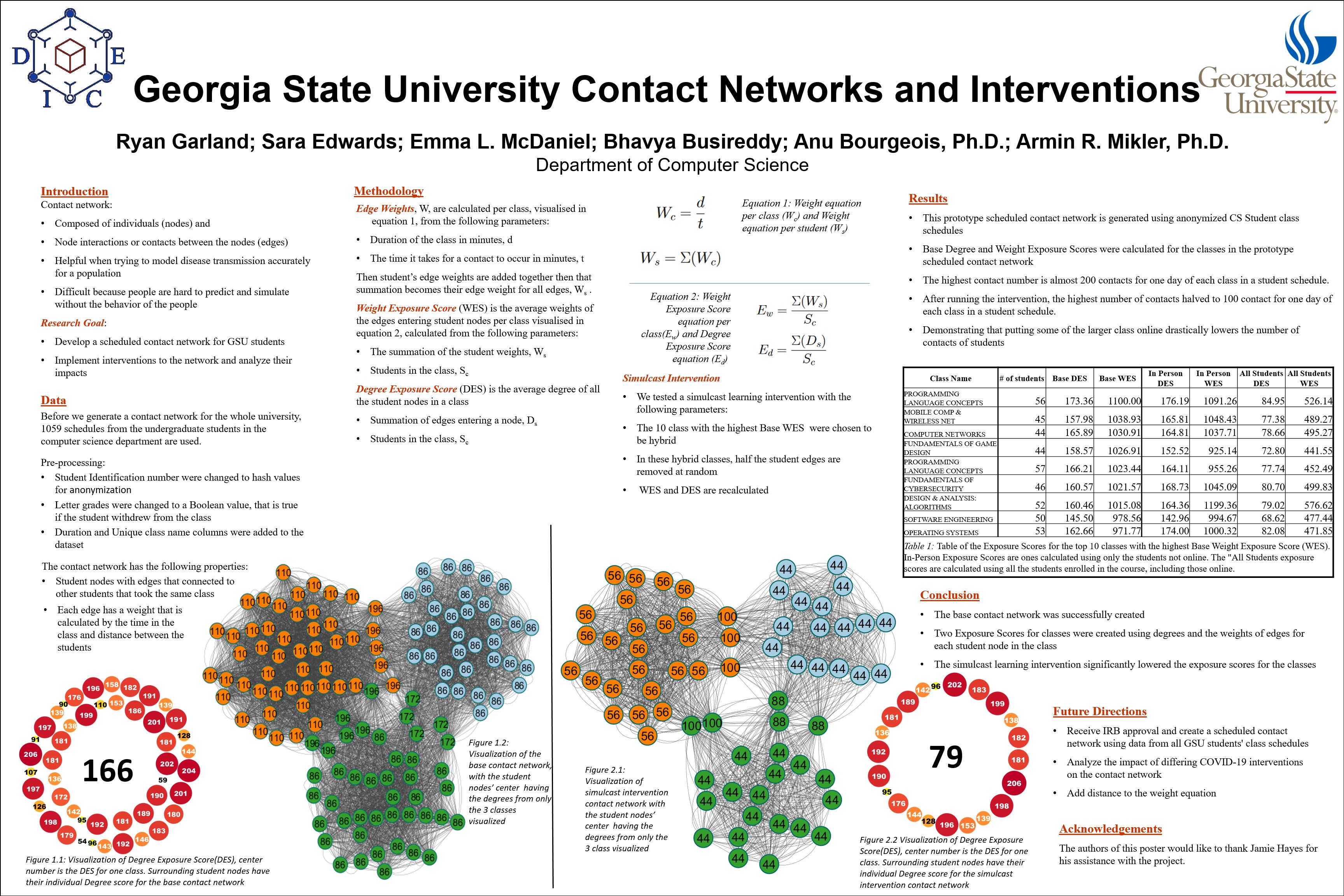
Georgia State University Contact Networks and Interventions
Ryan Garland; Sara Edwards; Emma L. McDaniel; Bhavya Busireddy; (Faculty Sponsors: Anu Bourgeois, Ph.D.; Armin R. Mikler, Ph.D.)
In graph disease modeling, creating realistic social networks can be an arduous task. We endeavor to use a graph constructed of course schedules to simulate the number of scheduled contacts that a student makes during their regular class day. This approach will allow for the examination of disease spread on a network of GSU college students’ scheduled contacts and the simulation of potential interventions that could be effective in minimizing disease spread. Using this model, we first determine the baseline of contacts that students have in a day. The deployment of specific interventions will then be simulated to assess their efficacy in controlling disease spread and reduction of contact weights. For these preliminary results, we are using preliminary data from only students that are Computer Science majors. The Computer Science department is the second-largest major at Georgia State University, and therefore this preliminary data is a suitable size for the start of this project. Eventually, the model will transition to using the schedules of all GSU students. The interventions that will be simulated on the graph network include but are not limited to simulcast-hybrid instruction, mask usage, quality of the mask, and increased time in between classes. Upon completion of this research, there will be a method to simulate different situations of disease spread on campus and test preventative measures, so actions can be taken to maintain the health and safety of the university.

Powered by Acadiate
© 2011-2026, Acadiate Inc. or its affiliates · Privacy