 CLOSE SIDEBAR
 Join Meeting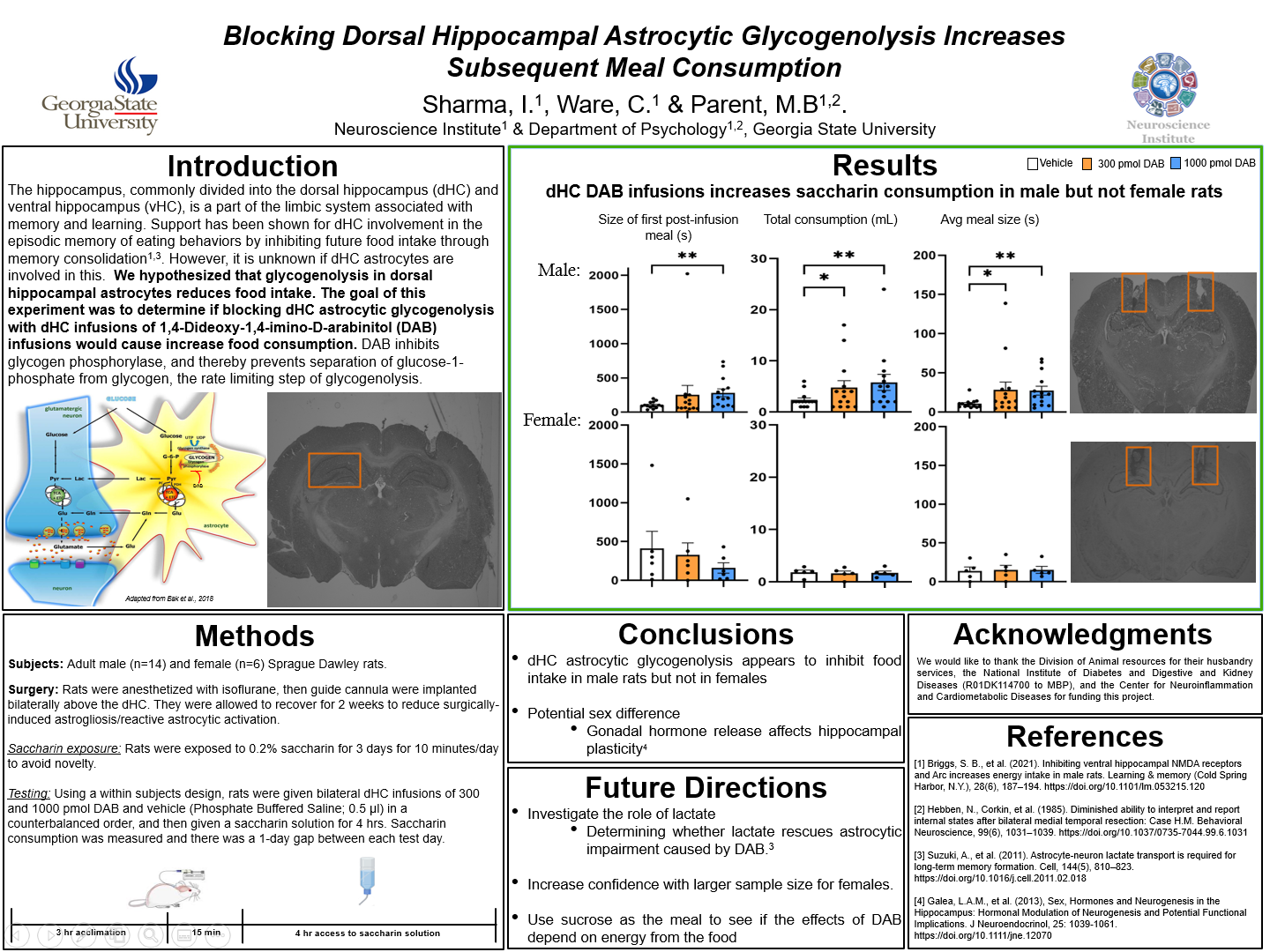
Blocking Dorsal Hippocampal Astrocytic Glycogenolysis Increases Subsequent Meal Consumption
Ishaan Sharma, Chris Ware, Marise B. Parent (Faculty sponsor: Dr. Parent)
Episodic memories of recent eating are key to regulating how much food is consumed later, and if memory is impaired as in cases of amnesia, then patients will consume a larger amount of food than healthy individuals. The molecular mechanisms related to the relationship between food intake and memory are still being discovered. Previously, our lab showed that dorsal hippocampal (dHC) neurons inhibit future food intake through processes that appear to involve memory consolidation. dHC astrocytes are known to be involved in memory consolidation and synaptic plasticity, but whether they influence eating is still unknown. Astrocytes are the only cells in the brain that appear to store energy as glycogen, which can fuel synaptic plasticity. We hypothesized that glycogenolysis in dHC astrocytes reduces food intake. In this experiment, Sprague-Dawley rats were exposed to saccharin for 3 days. We then infused 1,4-Dideoxy-1,4-imino-D-arabinitol (DAB), at varying concentrations (0, 300 and 1000 pmol/0.5 microliters in phosphate-buffered saline) in the dHC before presenting them with a saccharin solution on test days. Each rat received each dose in a counterbalanced manner on separate days. DAB inhibits glycogen phosphorylase and thereby prevents separation of glucose-1-phosphate from glycogen, which is the rate limiting step of glycogenolysis. Preliminary results based on a small sample size suggest that DAB infusions into dHC caused an increase in saccharin consumption in male rats in a dose-dependent manner but did not appear to have an effect in female rats. These results indicate that dHC astrocytes may be necessary for dHC inhibition of food intake in male but not female rats, suggesting a sex-dependent effect of how dHC astrocytic glycogenolysis reduces food intake.

Powered by Acadiate
© 2011-2026, Acadiate Inc. or its affiliates · Privacy