 Join Meeting
 CLOSE SIDEBAR
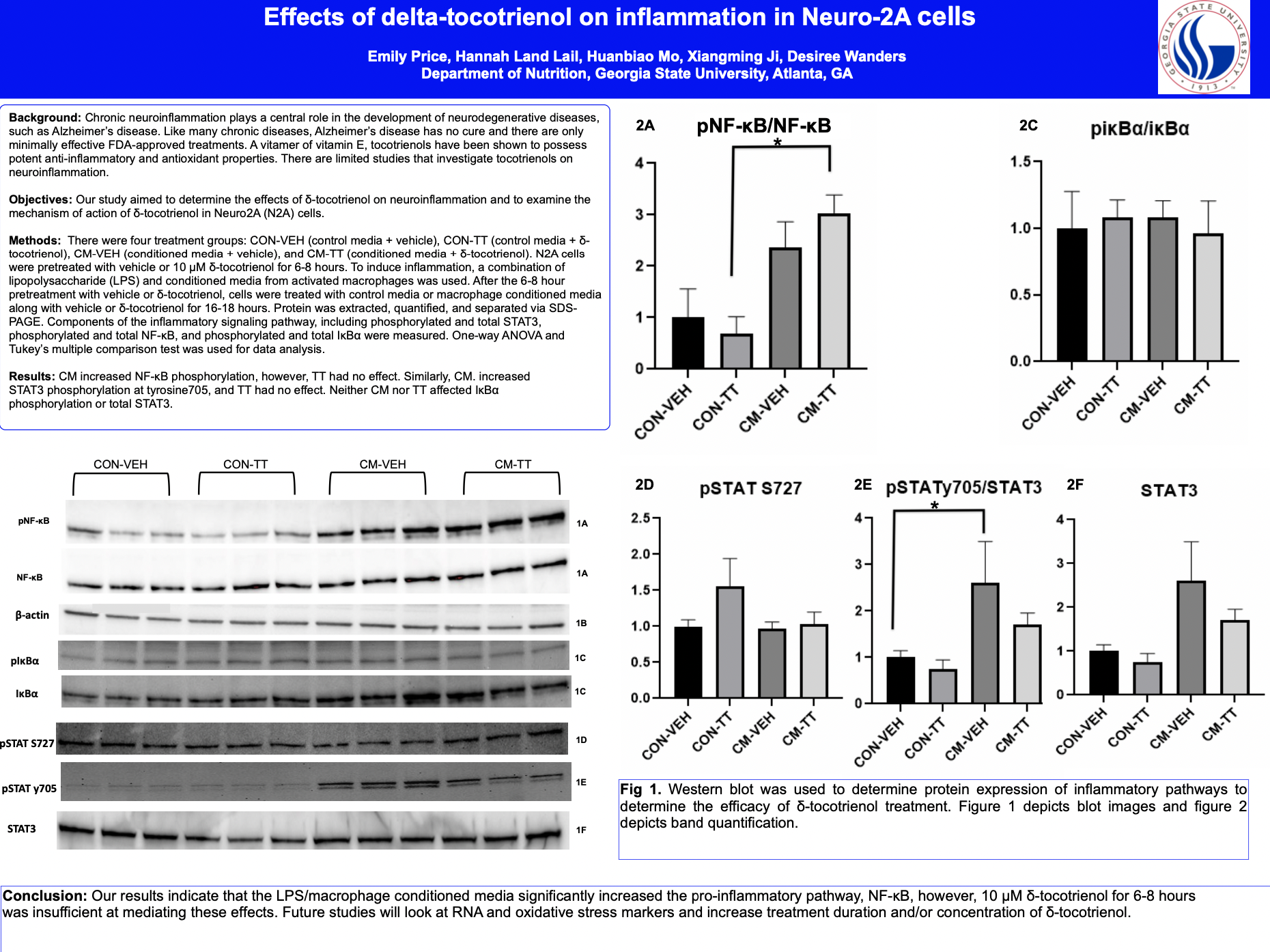
Effects of delta-tocotrienol on inflammation in Neuro-2A cells
Emily Price, Hannah Land Lail, Huanbiao Mo, Xiangming Ji, (Faculty Sponsor: Desiree Wanders)
Links
 Poster Presentation
Background: Chronic neuroinflammation plays a central role in the development of neurodegenerative diseases, such as Alzheimer’s disease. Like many chronic diseases, Alzheimer’s disease has no cure and there are only minimally effective FDA-approved treatments. A vitamer of vitamin E, tocotrienols have been shown to possess potent anti-inflammatory and antioxidant properties. There are limited studies that investigate tocotrienols on neuroinflammation.
Objectives: Our study aimed to determine the effects of δ-tocotrienol on neuroinflammation and to examine the mechanism of action of δ-tocotrienol in Neuro2A (N2A) cells.
Methods: There were four treatment groups: CON-VEH (control media + vehicle), CON-TT (control media + δ- tocotrienol), CM-VEH (conditioned media + vehicle), and CM-TT (conditioned media + δ-tocotrienol). N2A cells were pretreated with vehicle or 10 μM δ-tocotrienol for 6-8 hours. To induce inflammation, a combination of lipopolysaccharide (LPS) and conditioned media from activated macrophages was used. After the 6-8 hour pretreatment with vehicle or δ-tocotrienol, cells were treated with control media or macrophage conditioned media along with vehicle or δ-tocotrienol for 16-18 hours. Protein was extracted, quantified, and separated via SDS- PAGE. Components of the inflammatory signaling pathway, including phosphorylated and total STAT3, phosphorylated and total NF-κB, and phosphorylated and total IκBα were measured. One-way ANOVA and Tukey’s multiple comparison test were used for data analysis.
Results: CM increased NF-κB phosphorylation, however, TT had no effect. Similarly, CM. increased STAT3 phosphorylation at tyrosine705, and TT had no effect. Neither CM nor TT affected IκBα phosphorylation or total STAT3.
Relevant keywords
Nutrition Science
Updated
4 years ago
Powered by Acadiate
© 2011-2026, Acadiate Inc. or its affiliates · Privacy