Ask Me About My Poster!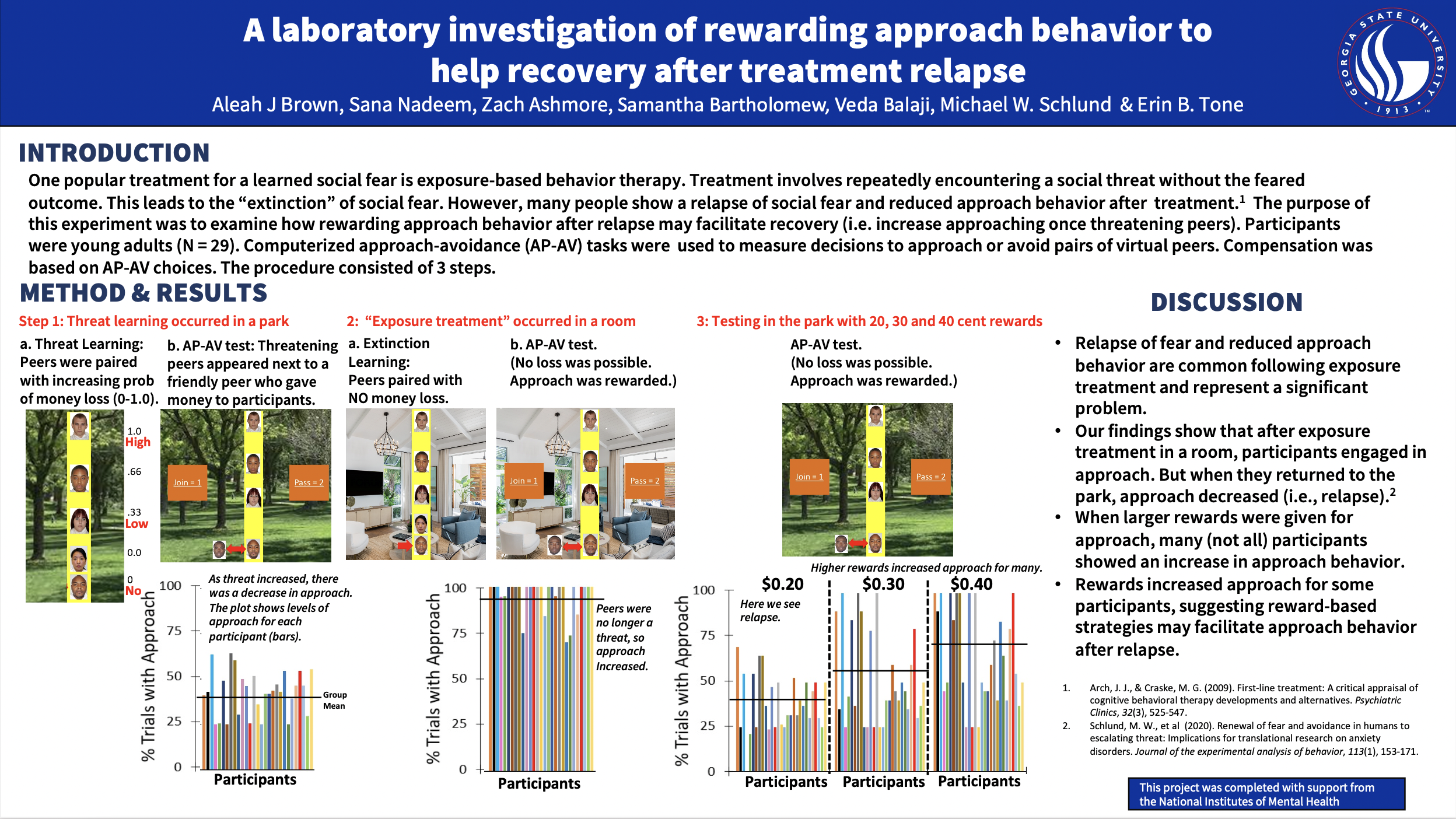
A Laboratory Investigation of Rewarding Approach Behavior to Help Recovery After Treatment Relapse
Aleah Brown, Sana Nadeem, Zach Ashmore, Samantha Bartholomew, Veda Balaji
One popular treatment for a learned social fear is exposure-based behavior therapy. Treatment involves repeatedly encountering a social threat without the feared outcome. This leads to the “extinction” of social fear. However, many people show a relapse of social fear and social avoidance after treatment. The purpose of this experiment was to examine how rewarding approach behavior after relapse may facilitate recovery (i.e. increase approaching once threatening peers). Participants were young adults. Computerized approach-avoidance (AP-AV) tasks were used to measure decisions to approach or avoid pairs of virtual peers. Compensation was based on AP-AV choices. The procedure consisted of 3 steps. During Step 1, five peers were paired with increasing probability of a 70-cent money loss. Next, an AP-AV test presented the threatening peers next to a friendly peer who gave money (20 cents) to participants. Approach produced 20 cents only if the threatening peer did not take 70 cents and avoidance prevented loss. Results showed that as social threat increased, avoidance increased, and approach decreased. Step 2 involved extinction learning. Here, peers were paired with no loss. When peers were presented during the AP-AV test, all participants chose to approach, demonstrating that the peers were no longer threats. During Step 3, participants returned to the park setting and tested for AP-AV. It should be noted that loss was suspended, but rewards could be earned for approach. Here, avoidance was completely unnecessary and approaching all the time was the most adaptive (and maximized gain). Results showed low levels of approach, consistent with relapse of avoidance. Next, the reward magnitude for approach was increased from 20 cents to 30 cents, and then to 40 cents. Increasing the reward magnitude for approach lead to immediate increases in approach for nearly all participants. Relapse of fear and reduced approach behavior are common following exposure treatment and represents a significant problem. Our findings show that after exposure treatment in a room, participants engaged in approach. But when they returned to the park approach decreased. When larger rewards were given for approach, nearly all participants exhibited an increase in approach behavior. There were also clear individual differences in the response to larger rewards. Our findings underscore the importance of using reward-based strategies for facilitating recovery after treatment.